
Customer Retention System for Small Business: Bring Them Back
Automated birthday, win-back, loyalty, and VIP touches that bring existing customers back — running in the background so the campaigns nobody at your shop has time for actually go out.
The problem
Every small business owner knows the math instinctively. The customer who has been coming in for two years is worth far more than the cold lead who clicked an ad. The regular who sends three friends a year is worth more than the one-time walk-in who does not come back. The patient who books a cleaning every six months on cadence is the foundation of the practice. Loyal customers are why the business has a floor under it at all.
The campaigns nobody on your team has time to send
And yet the campaigns that keep those customers loyal are the ones that do not get sent. The birthday text that should land on the customer's actual birthday — forgotten by Tuesday. The anniversary touch for the customer who has been a member for three years — skipped because nobody owns running it. The win-back outreach for the regular who has not been in for four months — buried under the front-desk workload of taking calls, booking new appointments, and running the day. The loyalty program that was supposed to drive repeat visits — running silently in the background with nobody reminding customers it exists. The VIP touch for the top ten percent of customers who account for forty percent of revenue — replaced by the same generic newsletter everyone else gets.
Why this is a workload problem, not laziness
The reason this happens is not laziness. It is workload. The front desk has a queue of in-the-moment work that cannot wait. The owner is delivering the actual service. The marketing tasks that compound over twelve months — the ones that are not urgent today but make next year's revenue — are the ones that fall off the table every single week. The result is a customer list full of relationships that go cold not because anything went wrong, but because nobody on your team has the bandwidth to keep tending to them at scale.
The slow drag of customers who quietly stop coming in
The cost of this neglected work shows up not as a line item but as a slow drag. Lapsed customers do not call to complain — they just stop coming in. The loyal customer who would have responded to a birthday text drifts to the competitor who actually sent one. The lapsed regular forgets you exist and finds someone else when they finally need the service again. None of it makes the dashboard. All of it shows up as revenue that should have come in and did not.

What changes for your business
A customer retention system fixes the workload problem without changing how your business actually feels to a customer. Instead of relying on the front desk or the owner to remember whose turn it is, the system runs all the retention campaigns in the background, on a schedule, in your business's voice. The four buckets work together — milestone touches, win-back sequences, loyalty rewards, and VIP recognition — so that every customer on your list is getting the right touch at the right time without anyone at your shop having to think about it.
Milestone touches on the actual day
Milestone touches go first because they are the easiest wins. A short SMS or email on the customer's actual birthday in your business's voice. An anniversary touch on the one-year mark of their first visit, the three-year mark, the five-year mark. A check-in on the anniversary of the last visit if it has been a while. Holiday touches your category cares about — graduation season for families, year-end for accountants, spring for landscapers. None of these are blasts; each one references something specific about the customer, sent on the day it matters, in language that sounds like a small business that remembered.
Win-back sequences for lapsed customers
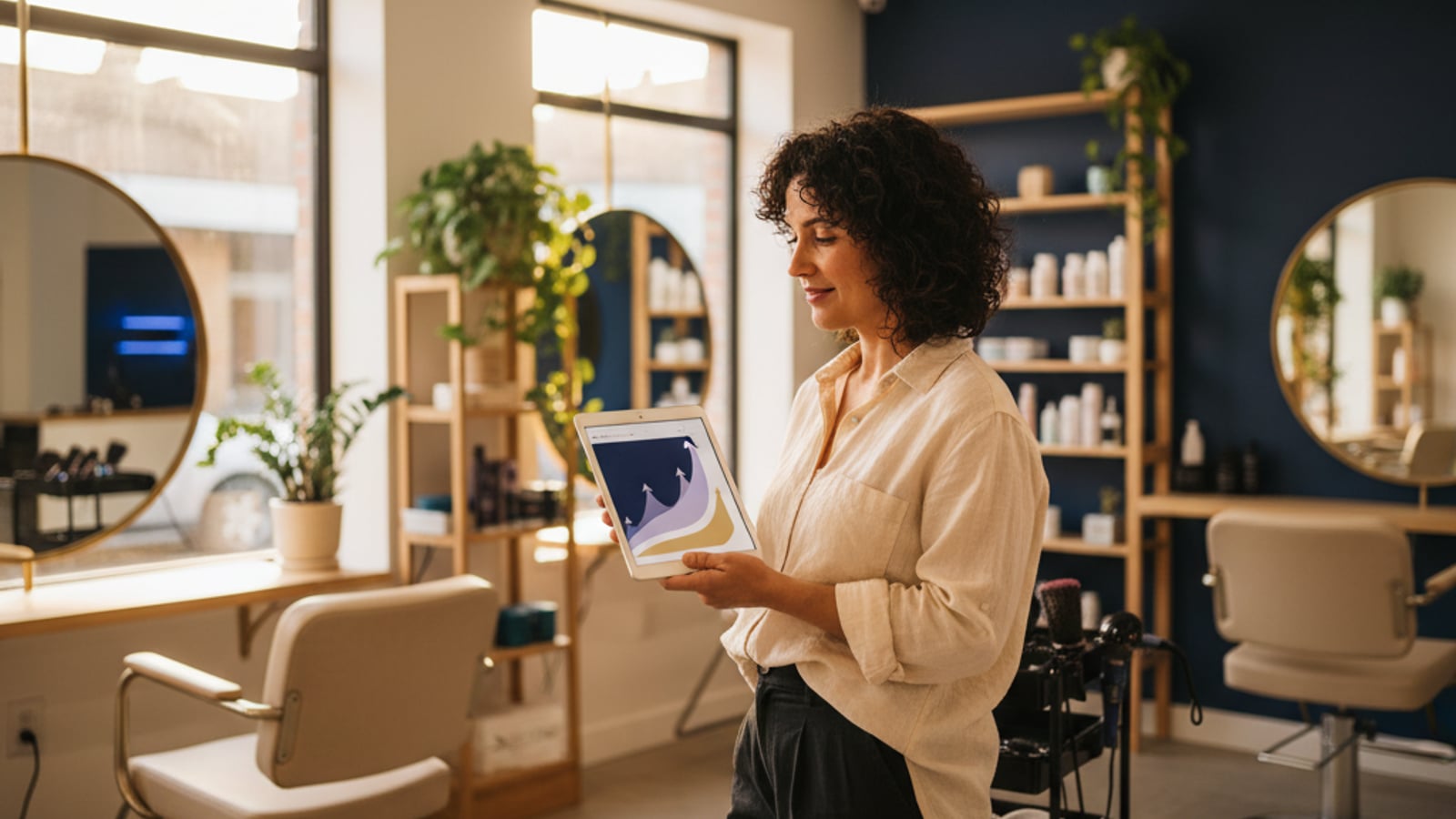
Win-back sequences are the highest-leverage piece for most of the businesses we talk with. The system watches your list for customers whose last visit is older than your category's typical cadence — eight weeks for a salon, six months for a dentist, twelve months for an HVAC tune-up, whatever fits your business. When a customer crosses that line, the win-back sequence fires. It is a structured three-to-five touch arc over two to three weeks, mixing SMS and email, that opens with a soft "we noticed it has been a while" and works through a category-appropriate re-engagement offer if the soft touch does not land. Most win-back research puts well-run campaigns in the 10-30% reactivation band — meaning one in three to one in ten of the customers who would have stayed gone come back.
Loyalty rewards that nudge the next visit
Loyalty rewards are the engine that nudges the next visit while the customer is still inside their typical cadence. The system tracks visits or spend, surfaces the reward at the right moment, and reminds the customer when they are one visit away from the next tier. McKinsey's loyalty research shows top-performing programs lift revenue from redeeming members by 15 to 25 percent annually — but also that roughly two-thirds of loyalty programs fail to deliver value, mostly because they run in isolation without the rest of a retention program around them. The system we build is the rest of the program: the birthday, win-back, anniversary, and VIP touches that turn the loyalty mechanic into a connected experience.
VIP recognition is the small layer that matters most to the top of your customer list. The system identifies the top tier — usually the top ten to twenty percent by lifetime value or visit frequency — and runs a different set of touches for them. A hand-finished holiday message. A first-look invitation when you launch something new. A small unexpected upgrade on their next visit. The kind of touches a small business owner used to be able to remember when the customer list was thirty people, and that fall off when the list grows past two hundred.
What we build for your business
The setup runs three to four weeks from kickoff to live, and lands as a working retention program that your team does not have to operate after week four.
What you get when the build is done: a consolidated customer list pulled from every place customer data lives in your business today — your booking system, your point-of-sale, your email tool, the notebook by the register if that is where the loyalty cards have been tracked. A first-week data audit and clean-up pass so the sequences have a coherent list to run on, with duplicate detection, gap-filling at the next visit (birthdays, anniversaries, preferred staff member), and a stable view of each customer's history. A custom set of milestone sequences — birthday, anniversary, last-visit anniversary, category-appropriate holiday touches — written in your voice with the specific offer or invitation that fits your business. A custom win-back sequence with the cadence and channel mix tuned for your category, the lapse threshold tuned for your typical visit interval, and the re-engagement offer tuned for your margin profile. A loyalty mechanic that fits how customers actually transact at your business — points, visits, spend, or a hybrid — with surfacing at the moments that matter and reminders when a customer is close to the next reward. A VIP layer that identifies your top tier automatically and runs a different set of touches for them, plus a weekly digest that flags which VIPs are close to a milestone so your team can add a personal touch when it counts.
Full opt-out handling that catches STOP, UNSUBSCRIBE, CANCEL, and the other standard keywords on the SMS side, and one-click unsubscribe on the email side, keeping the program inside the relevant compliance rules without you having to think about it. Integration into the booking, POS, or CRM tool you already use, so the retention layer sits on top of what your team already knows rather than asking them to learn another platform. A simple monthly report that shows how many touches went out, which sequences are converting, what the repeat-visit and reactivation rates look like, and which VIPs are coming up on a milestone — so the program keeps sharpening over time instead of going stale.
You stay in control of the offer, the voice, and the brand. We do the building, the wiring, the data work, and the tuning. After it goes live, the only thing your team has to do is keep doing the work that made customers loyal in the first place — the system handles the part where they get remembered.
Outcomes you should expect
What this delivers
- Lift repeat-visit rate 40-60% by running birthday, anniversary, milestone, and seasonal touches that go out the same week every customer hits the trigger.
- Reactivate 10-30% of lapsed customers through a structured win-back sequence — the band most retention research puts well-built campaigns inside.
- Recover 5-7x the cost of a new-customer acquisition by spending that budget on the customers you already have a relationship with.
- Save your front desk or owner 4-8 hours a week of remembering whose birthday it is, who hasn't been in for a while, and which VIPs deserve a hand-written touch.
- Make loyal customers feel seen by name and history rather than blasted with the same generic offer every other customer gets.
Industry data
By the numbers
The original Harvard Business Review research by Frederick Reichheld and W. Earl Sasser, 'Zero Defections: Quality Comes to Services,' established that companies can boost profits by close to 100% by retaining just 5% more of their customers — the foundational finding behind every modern customer-retention program.
A Harvard Business Review summary of Bain & Company research, 'The Value of Keeping the Right Customers,' reports that acquiring a new customer is anywhere from five to 25 times more expensive than retaining an existing one, and that increasing customer retention rates by 5% increases profits by 25% to 95% — the range varies by industry and customer mix.
Bain & Company's loyalty research published as 'E-Loyalty: Your Secret Weapon on the Web' documents that retaining 5% more customers can lift profits by 25 to 95%, that customer acquisition costs run 20 to 30% higher than for traditional businesses, and that new customers typically remain unprofitable for two to three years before purchase frequency and basket size compound.
McKinsey's loyalty research, 'Next in Loyalty: Eight Levers to Turn Customers into Fans,' reports that top-performing loyalty programs can boost revenue from redeeming members by 15 to 25% annually through higher purchase frequency, larger basket size, or both — but warns that roughly two-thirds of established loyalty programs fail to deliver value and some actively erode it.
The US Small Business Administration's 2024 Office of Advocacy report counts 34.8 million small businesses in the United States, representing 99.9% of all American firms and employing roughly 59 million workers — the vast majority of whom are running operations without a dedicated retention or loyalty manager.
Illustrative scenario
What this typically looks like
The scenario below is illustrative — a representative outcome for a business that fits this service profile, not a claimed client engagement.
What this looks like in practice. Picture a typical small salon with five chairs, a front-desk lead, and a customer list of roughly twelve hundred names accumulated over four years. Today, the owner sends a birthday email through the booking platform when she remembers — maybe a quarter of the time. There is a loyalty stamp card that customers half-use. There is no win-back outreach because nobody has time to look at the lapsed list. The owner has a sense that something like a third of the customer list has not been in for more than six months but has not done the count.
After the retention system is live, the picture changes in a way the owner notices in the books before she notices in the work. The birthday text fires for every customer on their actual birthday, in her voice, from her business's number — three to five a day land in customers' phones without her touching anything. The win-back sequence fires for any customer whose last visit was more than ten weeks ago, runs a three-touch arc over two and a half weeks, and tends to recover somewhere between one in six and one in three of those lapsed customers depending on category, offer, and how warm the relationship was. The loyalty mechanic surfaces the reward when the customer is one visit away from the next tier, which lifts the frequency on the regulars. The VIP tier — the top fifteen percent by visit count — gets a hand-finished holiday touch and first-look access when the salon adds a service.
The cumulative effect over the first three to six months is the kind of lift most retention research describes: repeat-visit rate up materially, lapsed customers reactivating at a rate the owner could not have hit by hand, and the loyal regulars saying things like "I love that you remembered." None of this is a guarantee for any specific business — outcomes depend on your average ticket, your category, your list size, how clean the underlying data is, and how warm your customer relationships were going in. These ranges are what we typically see for businesses of this shape.
Common questions
What buyers ask before reaching out
What exactly is a customer retention system, in plain terms?
It's the set of automated touches your business sends to people who already bought from you — birthday messages, anniversary check-ins, win-back outreach when someone hasn't been in for a while, loyalty rewards for the customers who keep coming back, and VIP recognition for the top tier. Today, most small businesses run none of this consistently because nobody owns it. A retention system runs all of it on a schedule, in your voice, without your front desk having to remember whose turn it is.
Why is retention worth more than just running ads for new customers?
The research is unforgiving on this. Harvard Business Review puts the cost of acquiring a new customer at five to 25 times the cost of keeping an existing one, depending on industry. Bain's loyalty work shows that lifting retention by just 5% can lift profits by 25 to 95%. For a typical small business, that means the dollars you spend on a retention program tend to outwork the same dollars spent on new-customer acquisition by a wide margin — because you are talking to people who already trust you.
What kinds of campaigns does a retention system actually run?
Four buckets, in our experience. First, milestone touches — birthday, anniversary, last-visit anniversary, first-visit anniversary, holidays your category cares about. Second, win-back — a structured sequence that fires when a customer hasn't been in for X weeks or X months, with the right re-engagement offer for your business. Third, loyalty rewards — a points or visit-based program that nudges the customer toward the next visit. Fourth, VIP recognition — a hand-finished touch for your top customers, the ones who account for an outsized share of revenue.
How is this different from the loyalty card I already have?
A punch card or a stamp app is one touch out of many — it rewards behavior in the moment but does nothing to bring back the customer who has not been in for three months. A retention system uses that loyalty mechanic as one channel among several, and wires in the birthday, win-back, anniversary, and VIP touches that the card alone cannot do. Most small-business loyalty programs underperform because they are running in isolation; a retention system makes the program part of a connected sequence of touches.
How personal can automated retention messages actually feel?
Personal enough that customers reply as if a real person sent them — when the system is set up right. The trick is using the data you already have: the customer's name, what they bought or booked last, when they last came in, who they typically see at your shop. A 'Hey Maria — it's been six months since your last cleaning with Dr. Chen, want to grab a time the week of the 14th?' lands very differently from 'Dear valued customer, we miss you.' The system writes the second category for you by default; the first category is what we build.
How long does it take to get a retention system running for my business?
A typical build runs three to four weeks from kickoff to live. The first week is a data audit — we look at your customer list, how clean it is, what fields you have on each customer (last visit, birthday, average ticket, preferred staff), and what gaps need filling. The second week is sequence writing — the birthday, anniversary, win-back, loyalty, and VIP touches written in your voice. The third week is wiring it into your booking or point-of-sale system and testing with real customer data. The fourth week is the tuning pass once you see how your customers respond.
What if my customer data is a mess?
That is the normal starting point. Most small businesses we talk with have customer data scattered across a booking system, a payment processor, an email tool, and a notebook by the register. The first week of the build is exactly this — pulling the data together, cleaning the obvious duplicates, filling in the easy gaps (birthdays at next visit, last-visit dates from the POS), and getting the list to a state where the sequences can run. You do not need a clean list to start; the process is part of the build.
Won't loyal customers feel weird getting automated birthday messages?
Only if the message reads like a marketing email. A short text from your business name on someone's actual birthday — 'Happy birthday from the team at [shop], enjoy a free [thing] on us this month' — lands as a thoughtful touch from a small business that remembered. The fail mode is a generic image-heavy email with a stock cake on it and a coupon code. The system we build sends short, conversational, on-brand messages that read the way a small-business owner would write if they had the time to remember every customer.
What does this typically cost a small business to run?
Most builds land in the $4-8K range for the setup, plus a monthly platform cost of $75-300 depending on customer-list size, message volume, and which underlying SMS, email, and loyalty tool the system runs on top of. For most of the businesses we talk with, the retention program tends to pay back within the first quarter on recovered visits alone, but that math depends on your average ticket, your current lapse rate, and your category — which we walk through on the fit call before anyone commits.
Does this replace the human relationships my business is built on?
No — it protects them. A small business owner who has been in the chair for ten years remembers the regulars by name, but cannot remember every customer's birthday, every six-month checkup, every lapsed visitor. The retention system is the memory layer that lets your team keep showing up as the human business you are, even as the customer list grows past what any one person can hold in their head. The relationships stay human; the system makes sure the touches do not get missed.
Ready to see what this looks like for your business?
A free 15-minute call. We talk about your business, the time and revenue you'd unlock with the right automation, and what the first 30 days could look like.