
Automation for Contractors and Landscapers — Win More Quotes
Win more of the quotes you write, fill the off-season with maintenance work, and turn finished jobs into a portfolio that brings the next customer in — without adding software your crews have to babysit.
The problem
A contracting or landscaping business runs on two things at once: the calendar your crews work this week, and the pipeline that fills next month, next quarter, and next season. When both are healthy the business prints money. When either one breaks, the gap shows up six to eight weeks later, after the season is already in motion and you cannot hire your way out of it.
Cold quotes
The bid that does not become a job is the first leak. Industry analysis of more than 438,000 contractor quotes shows the median contractor closes about three out of four quotes that reach a clear decision, but lost quotes typically sit a median of 29 days before anyone marks them lost. That is a month of pipeline going quietly cold while your team is on jobs. The homeowner did not pick a competitor in the moment — they picked the contractor who was still in front of them on day seven and day fourteen.
After-hours calls
The after-hours phone line is the second leak. Roughly 27% of calls to home-services businesses go unanswered, and less than 3% of callers who hit voicemail bother to leave a message. For a homeowner with a leaking roof at 7pm or a fence to replace before a Saturday party, voicemail is the same as a dial tone. They scroll to the next result. The next-day callback finds a closed door.
Seasonality
Seasonality is the third leak. Spring and summer pull crews to capacity; January and February eat into reserves while equipment notes and payroll stay monthly. Most contractors and landscapers know the off-season is where money sits unclaimed — winter pruning, snow contracts, gutter cleaning, paver sealing, fence repair, indoor remodels — but the work to actually reach the right past clients with the right offer rarely gets scheduled. By the time someone has the bandwidth in October, it is November.
Portfolio from finished jobs
The portfolio you should be building from every finished job rarely gets built. The before-and-after photo, the short write-up, the homeowner quote — that is the material that wins the next job on the next street. It also sits stuck on someone's phone or in a CompanyCam folder no one publishes from.
Review generation
The review you earned and did not ask for is the fifth leak. Most home-services contractors and landscapers know they should be asking. Most do it sporadically, when there is time, which means rarely. The result is a Google profile with one new review per quarter, slowly being out-ranked by the franchise across town that asks every customer.
The sixth leak is the repeat customer who would have hired you again and quietly hired someone else. Most home-services repeat business hinges on whether anyone remembers to follow up. Without a structured nudge, last year's pool service customer becomes this year's competitor's customer — not because anything went wrong, but because nobody asked.
What changes for your business
Automation for a contractor or landscaper is not about adding another piece of software your crews have to log into. It is about quietly handling the work that nobody on the team has time for, so the people you already employ can do what they are actually good at — running the jobs, talking to homeowners on site, and getting paid for the work you finish.
The model is straightforward. For each of the leaks above, we install a system that runs in the background, surfaces the exceptions that need a human, and reports in plain language on what it did this week. Your job management software — Jobber, JobTread, BuilderTrend, CompanyCam, LMN, whatever you already use — stays the system of record. The automation works around it, not against it.
Cold quotes
Quote follow-up becomes a structured cadence instead of an intention. A quote sent on Monday gets a friendly day-three nudge, a value-add touch on day seven, a final check-in around day fourteen, and a soft re-open at day thirty. The homeowner who went silent at day five often re-engages at day twelve when the season turns or their other estimate falls through. That is the homeowner the system catches.
After-hours calls
After-hours bid requests get caught by an AI chat assistant on your website that answers the common questions in your voice — service areas, what you do and what you do not, the rough timeline for the kind of job they are asking about — and either captures the lead with enough detail for a same-day callback or, where it makes sense, slots them into your intake calendar directly. When the same homeowner calls in business hours, your office picks up. The chat is not a replacement for your team; it is what catches the inquiries that would otherwise become voicemail.
Seasonality
Off-season outreach becomes a calendar rather than a memory. Last year's deck-build customer gets a friendly note in late summer about staining or sealing before winter. Last year's one-time lawn service gets a structured maintenance-contract offer in February. The crew who installed the fence in May gets a "how is it holding up" check in October that opens the door to repairs and adjacent work. None of it requires anyone holding last year's job list in their head.
Portfolio from finished jobs
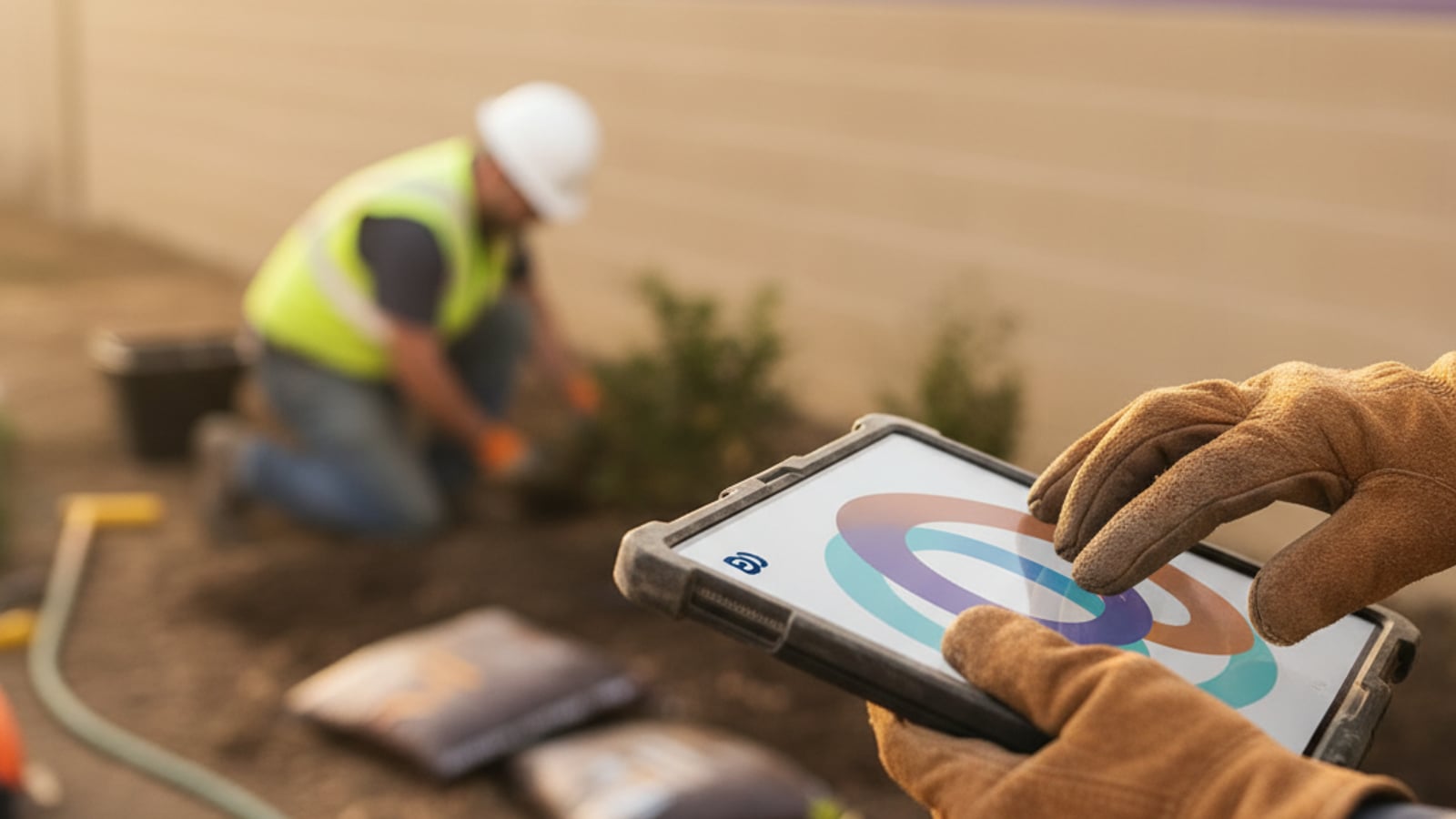
Photo and portfolio documentation gets built around what crews actually do — a phone in a work glove on a jobsite. A short capture flow with a couple of taps and a voice or text caption turns the job your crew finished today into usable before-and-afters for social, reviews, and the website without anyone sitting at a desk writing copy. The goal is a 30-second habit on the truck, not a 20-minute task at the end of the day.
Review generation
Reviews stop being something the office asks for in person and start arriving as a steady, well-paced flow. Timed asks go out at the right moment after a job wraps, with a one-tap path to Google for happy customers and a private feedback channel for anyone who is not ready to leave a public review. That keeps your public profile honest and gives you a heads-up on issues before they show up as a one-star rating.
Repeat business stops being a hope and becomes a calendar. Last year's clients are segmented by job type, season, and how much time has passed. The pool service customer gets a different rhythm than the kitchen-remodel customer. Loyal long-time customers get a low-pressure tone with an easy opt-down. The recall list stops being someone's unfinished task and becomes a system that quietly runs itself.
The outcome is the one contractors and landscapers actually want — more quotes won, work that fills the off-season, and a steady stream of repeat customers that does not depend on anyone remembering to call.

Services we build for contractors and landscapers
The six BoostFrame services map cleanly onto the leaks above. Each one is scoped on its own, so a contractor or landscaper can start with the leak that hurts the most and add the rest later.
- AI chat assistants — the after-hours capture layer on your website that answers homeowner questions in your voice and either captures the bid request with enough detail for a same-day callback or slots the right inquiry into your intake calendar. The first place most contractors see a measurable lift in inbound pipeline.
- Document automation — proposals, change orders, certificates of insurance, lien waivers, and contract paperwork that used to eat the office manager's morning. The system pulls the right data through your job management software and gives the office the final summary instead of the raw work.
- Social media multiplier — the content calendar that turns the photos your crews already take into a paced flow of before-and-afters, job spotlights, and seasonal posts. Builds the credibility homeowners check before requesting a quote, without pulling anyone off jobs to write captions.
- Lead nurture autopilot — the structured follow-up cadence that turns the quote sent on Monday into the job booked three weeks later. Day three, day seven, day fourteen, and a soft thirty-day re-open. The system catches the homeowners who would otherwise go cold.
- Review and reputation management — timed review asks after job completion with a one-tap path to Google for happy customers and a private feedback channel for anyone who is not ready to leave a public review. Steady weekly review flow instead of one a quarter.
- Customer retention system — segmented off-season outreach and maintenance-contract offers paced to your past customer list. Last year's one-time customer becomes this year's recurring customer without the office holding the calendar in their head.
A single-truck landscaper can start with one or two of these and grow into the rest. A multi-crew remodeler can roll the same setup out across crews and market areas with shared content and local tuning per service area. Either way, the first conversation is a 15-minute read on which leak is costing your specific business the most — and whether it makes sense to fix it now.
Outcomes you should expect
What this delivers
- Win more quotes by responding inside the window where contractors typically convert at 21x the rate of slower competitors
- Recover after-hours bid requests that would otherwise hit voicemail and never call back
- Fill the off-season with structured maintenance, recare, and seasonal-contract outreach instead of cold winters
- Turn finished jobs into a portfolio that fills itself — photo and write-up flows your crews can run from the truck
- Lift Google reviews from a handful per quarter to a steady weekly flow without anyone on the team asking in person
- Bring repeat customers back on a calendar instead of relying on someone remembering to call last year's clients
Industry data
By the numbers
Roughly 27% of calls to home-services businesses go unanswered, and less than 3% of callers pushed to voicemail leave a message — meaning a missed call is typically a lost lead, not a delayed one.
Analysis of 438,000 contractor quotes across 2,200+ businesses found the median contractor closes 73.9% of quotes that reach a decision, but lost quotes linger a median of 29 days before being marked dead — meaning slow follow-up is where most pipeline leaks out.
Jobber's 2026 Home Service Trends Report found that 34% of service pros cite weather and seasonality as a major growth constraint, while businesses earning $500K+ are roughly three times more likely to use AI than low-confidence peers.
The U.S. landscape services industry is roughly $188.8 billion in 2025 and employs over 1.4 million people across more than 690,000 businesses, with NALP's 2025 Financial Benchmark Study reporting median sales growth around 8.5%.
The National Association of Home Builders publishes ongoing market research used by contractors to benchmark margins, pipeline, and operations across residential remodeling and new construction.
Illustrative scenario
What this typically looks like
The scenario below is illustrative — a representative outcome for a business that fits this service profile, not a claimed client engagement.
What this typically looks like for a representative two-truck residential landscaping and hardscape company. Numbers below are illustrative ranges, not a claimed client outcome.
A two-truck landscaper in a suburban market has a baseline quote-to-job conversion in the 25-35% range across all leads, a strong spring and summer where crews are at capacity, and a winter where the owner is still doing payroll on jobs the cash flow no longer covers. Reviews come in maybe one a month from particularly happy customers. Last year's hardscape and planting clients are mostly remembered by name, not by a list.
After installing after-hours chat capture, a structured quote follow-up cadence, a review-generation flow timed to job completion, a photo-capture flow the crews can run from the truck, an off-season outreach calendar for past clients, and a paced reactivation flow for last year's one-time customers, the business typically sees a few things happen across the first season.
Quote-to-job conversion drifts up because more of the quotes that used to go cold at day seven now get a friendly check-in and a portion re-engage. After-hours inquiries from the website rise because more visitors at 8pm now capture instead of bouncing. Reviews accumulate at a steady weekly pace, lifting the Google profile out of the low-volume range where homeowners filter results. The off-season starts showing maintenance contracts and small-project bookings that used to belong to whoever the homeowner thought of first — which historically was not usually the company who did last year's install.
None of those are individually dramatic numbers. Together, they typically add up to a meaningful lift in revenue per season without the business having to hire a salesperson, change its job management software, or take time away from running jobs.
Common questions
What buyers ask before reaching out
We already use Jobber (or JobTread, BuilderTrend, CompanyCam, LMN). Do you replace it?
No. Your job management software stays the system of record for jobs, scheduling, invoicing, and crew dispatch. What we add sits around it — the after-hours capture, the quote follow-up cadence, the review-generation flow, the off-season outreach — so the data your team already enters is doing more work for the business. On the first call we walk through what your software exposes and where it makes sense to plug in versus stay out of the way.
Our close rate is decent — why would we change anything?
Decent close rates usually hide a slower problem: how many leads never reach a quote in the first place, and how many quotes go cold because nobody followed up at day three, day seven, and day fourteen. Industry data shows lost quotes typically sit a median of 29 days before anyone marks them lost — that is a month of soft pipeline you could have warmed. The work here is rarely about hard-selling; it is about being the contractor who is still in front of the homeowner when they finally decide.
How does this help in the off-season?
The off-season is where most contractors and landscapers leave money on the table. Past clients get a paced outreach for the seasonal services they already need — winter pruning, gutter cleaning, snow contracts, spring start-up, paver sealing, fence repairs. New maintenance contracts get a structured offer to last year's one-time customers. None of it requires anyone on your team remembering who got what last year — the system holds that calendar.
Photo documentation feels like a chore for crews — does this help?
Yes, but only if it is built around what crews actually do. A photo capture flow that fits a phone in a work glove on a jobsite, paired with a short voice or text caption, becomes a stream of usable before-and-afters for social, reviews, and the website without anyone sitting at a desk writing copy. The goal is to make documentation a 30-second habit on the truck, not a 20-minute task at the end of the day.
How does the review side work without it feeling pushy?
Reviews are timed and segmented. A homeowner who just had a project finished gets a different ask than a maintenance client who has been with you for two years. The ask itself is short, gives the customer a one-tap path to Google, and includes a private feedback option for anyone who is not ready to leave a public review. That keeps your public profile honest and gives you a heads-up on issues before they show up in a one-star rating.
We are a small operation — is this too much for us?
Small operations are where this work tends to pay back fastest, because the owner is usually the bottleneck on quotes, follow-up, and review-asking. Each piece scopes on its own. A one-truck landscaper can start with after-hours capture and the review flow, then add off-season outreach the following fall. A growing remodeler can start with the quote follow-up cadence and add the rest as the crew grows. There is no minimum size.
Who actually does the work — is this offshore or onshore?
BoostFrame is run by Bill Fackelman, the founder, in Oaklyn, NJ. Strategy, build, and ongoing tuning are handled in-house. You get a single point of contact who understands your setup, not a rotating account manager. For specialized creative or volume tasks we sometimes layer in trusted contractors, but the buck stops with one person.
What does pricing look like for a typical contractor or landscaper?
Pricing is scoped to the services you actually need, not a per-seat license bundle. A two-truck landscaping company that wants after-hours capture, a quote follow-up sequence, and review generation looks different from a multi-crew remodeler that needs document automation, off-season reactivation, and a social calendar across two market areas. The 15-minute call is where we scope it. There is no obligation to continue after that conversation.
Ready to see what this looks like for your business?
A free 15-minute call. We talk about your business, the time and revenue you'd unlock with the right automation, and what the first 30 days could look like.