
Social Media Content for Contractors and Landscapers — From the Truck
Project portfolio reels, seasonal-service posts, and a CompanyCam-to-Instagram flow your crews can run from the truck — without anyone editing clips after dinner.
The problem
Every contractor and landscaper has the same uncomfortable conversation about social media at some point. The owner knows the feed should be active. The owner sees the company across town posting fence-install timelapses every week and kitchen reno before-and-afters that get hundreds of likes. The owner has tried — sometimes personally on a Sunday afternoon, sometimes by handing it to whoever in the office had a few spare hours, sometimes by paying an agency $1,500 a month for a content calendar that ended up looking like every other landscaping company on their roster. None of it sticks past the second month. The Instagram has a flurry of posts from April when somebody had the time, then nothing through the busy summer. The Facebook page last posted before Thanksgiving. The Google Business Profile photos are from a renovation two seasons ago. Meanwhile a homeowner shopping for a contractor lands on the profile, sees a feed that looks abandoned, and quietly clicks to the next result.
Time tax on the owner
Three things keep contractors and landscapers stuck in this loop. The first is the time tax. Crews run from 7am to 5pm in season; the owner is on quotes, payroll, equipment, and the half-dozen fires that come up before lunch. Sprout Social's 2024 data, drawn from nearly 3 billion messages across more than a million brand profiles, puts the industry-average posting cadence at 9.5 posts per day across networks — roughly five on Facebook, one to two on Instagram, two on X, one on LinkedIn. No owner-operated contracting or landscaping company is hitting that by hand, and most cannot sustain even three posts a week through a full season before the calendar goes silent. The owner who tried doing it personally got six weeks in before the May rush closed the door. The office manager who got handed the assignment dropped it the first week things got busy. The agency the company tried sent template-y graphics that could have been any landscaping outfit in the country.
Photos that never become posts
The second thing is that the photo side feels like a chore that does not add up. Crews take photos in CompanyCam, JobTread, BuilderTrend, LMN, or the camera roll. The photos sit there. Nobody has time at the end of the day to write a caption, pick a format, decide what platform it goes on, and schedule a post. By the time the owner thinks about pulling something usable out of the last month of jobs, the photos are buried under three weeks of newer ones and the moment has passed. The before-and-after of the kitchen reno the crew finished in early March is exactly the post that would have won the kitchen reno on the next street in late March — but nobody published it.
Seasonal swing the calendar misses
The third thing is seasonality. The U.S. landscape services industry runs roughly $188.8 billion across more than 690,000 businesses according to NALP, with median sales growth around 8.5% per their 2025 Financial Benchmark Study — but the revenue inside any single operator's year is wildly uneven across the seasonal swing. Jobber's 2026 Home Service Trends Report finds 34% of service pros name weather and seasonality as their biggest operational challenge limiting growth, the largest single factor in the survey. The off-season is exactly when social should be pre-booking spring cleanups, snow contracts, paver sealing, fence repair, and indoor remodels — but the work to actually plan that calendar, write the seasonal-announcement posts, and time them to the booking window rarely gets scheduled by a busy owner.
The cost of an abandoned feed
The cost of staying in the loop does not show up on the P&L as a line item. It shows up as the homeowner who chose the company with the active project reel page over yours, which had not been updated since spring. It shows up as the empty December and January slots that maintenance contracts and snow work would have filled if last year's install clients had seen a paced sequence of seasonal offers in their feed. It shows up in a Google Business Profile that is not ranking in the local 3-pack because Google's prominence signal flags the listing as inactive. Jobber's 2026 data has Facebook as the largest social-driven lead source for home-service businesses at 32% of owners' top channels, ahead of Google Search at 20% and Local Services Ads at 19% — and the social-driven lead source only works if the profile a homeowner clicks through to looks like a company that is busy and credible today.
What changes for your business
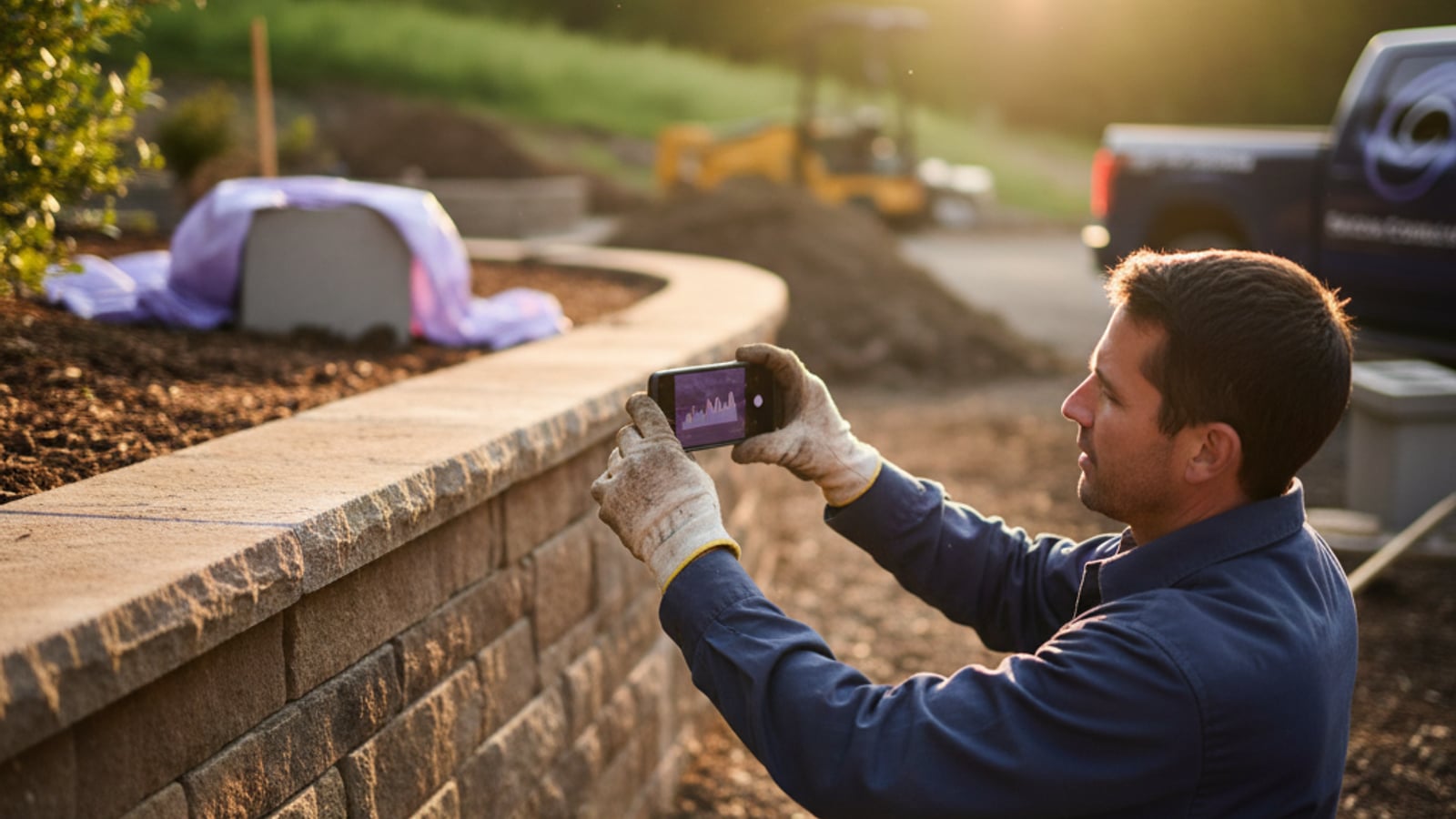
A social media content multiplier built for a contracting or landscaping company fixes the time problem, the photo problem, and the seasonal-calendar problem in the same workflow. The input is small and sustainable, built around what crews already do. If your team already uses CompanyCam, JobTread, BuilderTrend, or LMN to document jobsites, the multiplier integrates against the photos and project tags they already create — your crews keep their existing workflow, and the social output runs downstream of it. If your crews are still capturing photos in the phone camera roll, we set up a simple shared folder or one-tap upload link that fits a hand in a work glove on a jobsite. The capture target is 30 seconds at the end of a workday, not 20 minutes at a desk.
CompanyCam-to-post pipeline
From those crew-captured photos, plus two or three short owner-recorded videos a month, the multiplier produces a full month of finished content across every channel that matters for a contractor or landscaper. A kitchen reno that wraps in mid-March becomes a start-to-finish reel with the demo, the framing-and-rough, the cabinet install, and the final reveal — cut for Instagram Reels, TikTok, Facebook, and YouTube Shorts, with image carousels for the feed, a Google Business Profile post, and a paragraph for the next email newsletter. A fence install becomes a one-minute timelapse with crew commentary. A paver patio becomes a before-and-after carousel with the homeowner-quote graphic pulled from the punch-list email. Two or three monthly owner videos and a steady stream of crew project photos typically yield 30 to 50 finished posts across channels — substantially more volume than an agency at twice the price, paced across the month so the feeds stay actively updated.
Seasonal calendar that pre-books
The seasonal calendar runs against the swing your specific business actually lives in, not against a generic content template. Spring cleanup booking announcements go out in late February, before homeowners start shopping for a crew. Aeration and overseeding posts hit in early September. Snow contract sign-up campaigns go live in September and October, well ahead of the first frost. Paver sealing season posts queue up in early summer. The deck-staining and fence-repair window opens after the spring rush ends. Past clients who got an install last summer get a contextual nudge for the maintenance add-on; last year's one-time customers get a structured maintenance-contract offer paced to the season they are about to enter. None of it depends on the owner remembering in October that the snow campaign should have started in September — the system holds the calendar, and the social feed becomes the channel that pre-books the off-season pipeline.
Voice profile that sounds like the company
The voice profile is built from how your business actually talks — the way the owner signs the email after a finished job, the language the office uses on the quote, the tone the crew lead takes on a walkthrough. Captions are written from the project notes and the owner-recorded videos in that voice, then run through voice guardrails that flag anything drifting toward generic-agency-template territory before it posts. Jobber's 2026 data shows 52% of home-service business owners already use AI in operations, jumping to 64% of owners under 30, with the top uses being quoting, invoicing, and email or proposal drafting — content production and repurposing falls into the same category of repeatable work that pays back fastest when offloaded from the owner, as long as the output still sounds like the company.
What this changes for the business is the part that compounds. A visibly active feed full of recent project work is the trust signal that turns a homeowner's social check, the one almost every homeowner does before requesting a quote, into a booked estimate. The Google Business Profile gets a weekly post in the same content stream, which feeds the prominence signal that influences whether the listing shows up in the local 3-pack for searches like "landscaper near me" or "deck builder near me." The off-season pipeline starts filling from past clients who saw a seasonal-service offer paced into their feed instead of getting a cold reactivation email three months too late. None of this happens from one great project reel. All of it happens when the feed is visibly active for six months in a row across the full seasonal swing — which is what the multiplier makes possible without anyone on the team writing a caption.

What we build for contractors and landscapers
The setup runs three to four weeks from kickoff to live and lands as a system that runs on a CompanyCam-or-equivalent feed plus two or three monthly owner videos forever, without further engineering on the company's end.
The jobsite-photo integration comes first. If your crews use CompanyCam, JobTread, BuilderTrend, or LMN, we wire the multiplier downstream of the project photo stream so tagged projects flow into the production pipeline automatically. If your crews are still capturing in the phone camera roll, we set up a one-tap upload flow built for a hand in a work glove — typically a project name, a service-type tag, and the milestone shots (before, mid, after) the crew already takes. The capture target stays at 30 seconds per jobsite, paced into the natural rhythm of a workday rather than added as another end-of-day task.
The voice profile and visual identity capture comes next. We pull from the company's existing emails, quote language, punch-list notes, and any past posts that actually sounded like the company — and we build a voice guide and a visual identity treatment that runs across every output. Fonts, color, lower-third treatment, project-card layout, opening and closing graphics. The treatment travels with every clip and every carousel regardless of which crew shot the source photos.
The multi-format production pipeline takes each project's photos and owner videos and produces vertical Reels and TikTok cuts of project timelapses and before-and-afters, horizontal Facebook and YouTube versions, square feed carousels, accurate auto-captioning verified against transcripts on the owner-recorded videos, quote graphics from customer punch-list notes and project emails, project-spotlight captions in the company's voice for each platform, a weekly Google Business Profile post, a section for the customer email newsletter, and a short blog excerpt that links back to the service pages.
The seasonal calendar layer paces the content stream against the swing the specific company lives in — spring cleanup booking windows, snow contracts, paver sealing season, fall aeration, fence-repair and deck-staining windows, indoor-remodel season for general contractors. The system holds the dates and queues the seasonal-announcement campaigns automatically; the owner does not have to remember in September that the snow contract campaign should be live.
The scheduling layer posts each format at the time the platform analytics show the company's audience engages, paced across the month so the feeds stay actively updated without flooding any one day. The Google Business Profile gets a weekly post in the same content stream.
The engagement routing layer surfaces comments, DMs, and Google Business Profile messages to the right person in the office in the channel they already use — so the moment an engaged homeowner lands, the team picks up the conversation and the automation steps aside.
The weekly report shows what went out, what performed, which formats are doing the heaviest lifting, which projects are getting cut and reused most often, and which Google searches are driving the GBP impressions. The owner can scan it in two minutes and see the system getting sharper as it learns what the local market responds to.
The company stays in control of the input — what crews tag, what owner videos get recorded, which projects get the spotlight treatment. We do the building, the wiring, the seasonal calendar, the production, and the tuning. After the system goes live, the company's ongoing task is the photo workflow the crews already run, two or three short owner videos a month, and responding to the engaged-homeowner notifications that land in the office inbox.
Outcomes you should expect
What this delivers
- Turn the photos your crews already capture in CompanyCam (or any jobsite photo app) into a paced flow of finished posts — before-and-afters, project reels, seasonal-service announcements — without anyone editing clips at night.
- Keep the social feed and Google Business Profile visibly active through the full seasonal swing, so a homeowner checking you in October sees recent work, not last June's last post.
- Pre-book spring cleanups, fertilization rounds, and snow contracts from the audience that already followed you for the install or hardscape job you finished in summer.
- Cut social-content production time from the 5-10 hours a week most owners try (and quietly drop after two months) down to roughly 30 minutes a month of phone-video recording from the truck.
- Build the portfolio that wins the next job on the next street — recent project posts are what a homeowner scrolls before requesting a quote, especially in a fragmented local market where every company looks similar on paper.
- Stay credible on Google Business Profile so 'landscaper near me' or 'deck builder near me' searches put your listing in the local 3-pack with recent photos and project posts, not a stale gallery from two seasons ago.
Industry data
By the numbers
Jobber's 2026 Home Service Trends Report identifies Facebook as the single largest social-driven lead source for home-service businesses, cited by 32% of owners as a top channel, with Google Search at 20% and Local Services Ads at 19% — meaning the visible profile a homeowner clicks through to from a Facebook post or Google listing is doing real top-of-funnel work, not just brand decoration.
The same Jobber 2026 report finds 34% of service pros name weather and seasonality as their biggest operational challenge limiting growth — the highest single factor in the survey — which is the operational case for using the off-season to keep the social feed visibly active and to pre-book spring work from the audience your finished-job posts already attracted.
Jobber's 2026 data also shows 52% of home-service business owners now use AI in operations, climbing to 64% among owners under 30, with the top uses being quoting, invoicing, and email or proposal drafting — content production and repurposing is the same category of repeatable work that pays back fastest when it is offloaded from the owner.
Sprout Social's 2024 analysis of nearly 3 billion messages across more than a million public brand profiles puts the industry-average posting cadence at 9.5 posts per day across networks — roughly 5 on Facebook, 1-2 on Instagram, 2 on X, 1 on LinkedIn — a volume no owner-operated contracting or landscaping company can sustain by hand alongside running crews.
The National Association of Landscape Professionals reports the U.S. landscape services industry at roughly $188.8 billion in 2025, with more than 690,000 businesses employing over 1.4 million people, and NALP's 2025 Financial Benchmark Study putting median sales growth around 8.5% — a fragmented, locally-decided market where visible portfolio content is one of the few ways a single operator stands apart from the company on the next street.
Illustrative scenario
What this typically looks like
The scenario below is illustrative — a representative outcome for a business that fits this service profile, not a claimed client engagement.
This is an illustrative scenario, not a description of a specific client engagement. It shows the shape of the math, not a promised outcome.
Picture a two-truck residential landscaping and hardscape company in a suburban market. Today the Instagram has 540 followers, a last post from eleven weeks ago that pulled 18 likes, and a Google Business Profile that has not been touched since the last summer promotion ended. The company runs CompanyCam on every job and has roughly six months of tagged project photos sitting in the app that nobody has published from. The owner gets a steady but unremarkable flow of quote requests — most from Angi and Google Search, some from referrals, a small handful from organic social.
After the multiplier goes live, the photo pipeline starts running against the CompanyCam projects the crews are already tagging. The first month publishes a paver patio before-and-after carousel from a job that wrapped two weeks before launch, a fence install timelapse from the previous Friday, a spring cleanup reel that pulls from three different early-season jobs, and a Google Business Profile post with a customer quote pulled from a punch-list email. The owner records three short phone videos that month — one walking through how the company quotes hardscape work, one explaining the difference between mulch types ahead of spring delivery season, one Saturday-morning crew-huddle clip. Those photos and videos become roughly 42 finished posts across Instagram, Facebook, Google Business Profile, TikTok, and email over the month.
Inside six weeks, Instagram reach climbs from a few hundred per post to a few thousand as the algorithm picks up the consistency. The Google Business Profile starts showing in more "landscaper near me" searches in the surrounding ZIP codes. By month three, the front office hears "I saw your video" or "I saw the patio reel" from three or four quote requests a week. By month six, the late-summer feed has pre-booked a meaningful chunk of the fall aeration, snow contract, and paver-sealing pipeline from past clients who saw the seasonal-service posts paced into their feeds two months earlier. The setup cost typically pays for itself before month four at average ticket sizes for the category.
The actual numbers will shift with the company's specific market, average ticket, case mix, and the strength of the source footage and crew photos. The shape of the math holds.
Common questions
What buyers ask before reaching out
We already use CompanyCam (or JobTread, LMN, BuilderTrend) for job photos. Do you replace it?
No. CompanyCam, JobTread, LMN, and the rest stay where they are — that is where your crews already document, where the photos already live, and where the project records belong. The multiplier sits downstream of it. The system pulls the project photos and short captions your crews tag, runs them through the production pipeline, and turns them into finished posts across Instagram, Facebook, Google Business Profile, TikTok, and email. Your crews keep the workflow they already know; the social output runs from the photos they already take.
What kinds of posts actually work for a contractor or landscaper?
Three formats do most of the heavy lifting. Project portfolio reels are the workhorse — kitchen renovation start-to-finish edits, fence install timelapses, paver patio before-and-afters, deck build progression, lawn renovation transformations. These are the posts homeowners screenshot and send to a spouse before requesting a quote. Seasonal-service announcement posts come second — spring cleanup booking windows, fall aeration, snow contract availability, paver sealing season. These pre-book the off-season pipeline. Trust-builder content is the third — short clips of the owner explaining how a quote works, a crew lead walking through a finished job, a behind-the-scenes look at a Saturday-morning huddle, customer-quote graphics. The mix that compounds is roughly 60% portfolio, 25% seasonal, 15% trust-builder.
Our crews barely have time to take photos as it is — how does this not become more work for them?
It does not add a step. If your crews already use CompanyCam or a similar jobsite photo app, the only adjustment is making sure projects are tagged in a way the multiplier can pick up — typically a project name, a service type tag, and a couple of milestone shots (before, mid, after). If your crews are still taking photos in the phone camera roll, we set up a simple shared folder or capture link that fits one hand on a jobsite. The capture target is 30 seconds at the end of a workday, not 20 minutes at a desk. The owner-recorded videos — two or three short clips a month, talking through a recent project or a seasonal-service offer — are the only piece that does not come from crew photos.
How does the seasonal piece actually work?
The social calendar is laid out against your seasonal swing, not against a generic content calendar. Spring cleanup announcements go out in late February so the booking window opens before homeowners go shopping. Snow contract sign-ups go live in September. Paver sealing season hits in early summer. The deck-staining and fence-repair window opens after the spring rush ends. The system holds the calendar; you do not have to remember in October that you should have started the snow campaign in September. Past clients who got an install last summer get a contextual nudge for the maintenance or seasonal add-on — the multiplier produces the post and the system surfaces the audience.
How is this different from the agency that quoted us $1,500-$2,500 a month?
Most agencies at that price run 30-50 home-service accounts on the same content engine — generic landscape graphics, stock paver photos, captions stitched from a swipe file. The Instagram feed could have been any company on their roster. The multiplier here is the inverse — every photo comes from a real job your crew finished, the captions run through your voice profile so they sound like your business and not a template, and the output volume is meaningfully higher (typically 30-50 posts a month across channels versus an agency's 8-15). Production happens automatically once your CompanyCam or upload link feeds the pipeline; there is no weekly approval cycle slowing it down.
Does this actually drive quote requests or is it just brand-building?
Both, in that order. The brand-building piece — being visibly active on Facebook, Instagram, and Google Business Profile — is what makes a homeowner take you seriously when they land on your profile from a Google search or a neighbor's referral. Jobber's 2026 Home Service Trends data has Facebook as the largest social-driven lead source for home-service businesses, cited by 32% of owners as a top channel, ahead of Google Search at 20% and Local Services Ads at 19%. The quote-request piece comes from the portfolio reel a homeowner saw a week ago that matches what they are now considering — the kitchen reno that looks like theirs, the paver patio in the next subdivision, the fence install that solved the same problem they have. Recent portfolio posts are what turn a follow into a quote request.
What does this typically cost a contracting or landscaping company?
Setup for a single-market contracting or landscaping company usually lands in the $4-8K range — that covers the CompanyCam (or equivalent) integration, the voice and visual identity capture, channel connections to Instagram, Facebook, Google Business Profile, TikTok, and email, plus the first 30 days of seasonal content templates. Monthly run rate after that typically sits in the $400-1,200 range depending on how many channels are live and how much editing the raw footage and photos need. We walk through the math against your specific case mix, average ticket, and local market on the 15-minute fit call before anyone commits — pricing is grounded in your actual numbers, not a generic quote.
What if we serve multiple markets or have multiple crews?
Multi-market and multi-crew setups are common in landscaping and remodeling. The voice profile and visual identity stay shared across the company, but the seasonal calendar gets tuned per service area — a coastal market and an inland market have different snow exposure and different spring-cleanup windows. Crew-level content credits can show up on posts where it makes sense, so the team feels recognized. We scope the multi-market setup on the fit call against the geography and crew structure you actually run.
Ready to see what this looks like for your business?
A free 15-minute call. We talk about your business, the time and revenue you'd unlock with the right automation, and what the first 30 days could look like.