
Social Media for Salons & Barbershops — No Midnight Canva
Transformation Reels, stylist features that drive rebookings, and weekly Google Business posts — without the owner thumbing through Canva at midnight.
The problem
Every salon and barbershop owner has had some version of this conversation about social. The owner knows the feed should be active. Competitor shops in town are posting weekly balayage transformations and fresh-fade Reels that pull thousands of views. The owner has tried — sometimes personally, sometimes by handing it to the strongest stylist on the team, sometimes by paying an agency $1,500 a month. None of it sticks past the second month. The Instagram has a flurry of posts in late spring, then nothing through summer. The TikTok has eleven videos and a last post from before the holidays. The Google Business Profile still shows the renovation photos from two years ago. Meanwhile a prospective client lands on the profile from a search, sees a feed that looks abandoned, and books with the shop across town that posted a fade transformation yesterday.
The time tax on chair-side teams
Sprout Social's 2024 data, drawn from nearly 3 billion messages across more than a million brand profiles between February 2024 and January 2025, puts the industry-average posting cadence at 9.5 posts per day across networks — roughly five Facebook posts, one to two Instagram posts, two on X, one on LinkedIn, one on Pinterest per week. No chair-side shop is hitting that by hand. Most shops cannot even sustain three posts a week for a full quarter before the calendar goes dark. The stylist who got the assignment at the team meeting dropped it the first time the schedule got rough. The owner who tried doing it personally got six weeks in before back-to-back color corrections closed the door. The agency that was supposed to handle it sent template-y balayage stock photos that could have been any salon. Pro Beauty Association puts the average internet user at over 17 hours per week on social media, and the bright-line rule the association publishes for salons is unambiguous — it's better to post infrequently but consistently than to post every single day for a stretch and then post nothing for weeks afterward. Most shops cannot hit either of those bars by hand.
Photo-release exposure on every transformation
Before-and-after content is the workhorse of the category — Pro Beauty Association calls before-and-after pictures "especially important in the hair and beauty industry" because they showcase the work quickly and effectively, and Booksy's salon marketing guidance calls out that high-impact transformations "capture attention instantly" when the source footage is the shop's own real client work. But every recognizable client face in a Reel, every chair-side clip with a client in frame, every transformation post is a legal question. A client whose photo went up without a signed release can ask for it down — and increasingly, will. Most shops know this in principle. Few have a working release flow — a one-page form, a place to file the signed releases, a documented takedown process if a client revokes consent — and even fewer have the discipline to route every post through it before the photo gets to the queue. The result is that the lowest-risk path becomes posting nothing at all, which is exactly the path that lets the feed go quiet.
Shop brand and stylist brand pulling apart
The shop's social presence and each stylist's personal brand often pull in different directions. Clients build relationships with specific stylists. A regular is loyal to Jess, not to "the salon" — and when Jess opens her own chair across town, that regular follows. The shop owner has every reason to want stylists growing personal books on Instagram and TikTok, because that growth brings foot traffic to the shop. But most shops do not have a system that lets stylists repost the shop's content to their personal feeds in a way that stays on brand, names them as the artist, and routes new bookings to their chair. The feed and the team end up working past each other instead of compounding together.
The cost of staying in the loop does not show up on the P&L as a line item. It shows up as the prospective client who chose the shop with the active transformation Reel over yours. It shows up as the existing regular who would have referred a friend if the feed had given her something easy to share. It shows up in a Google Business Profile that does not rank in the local 3-pack because Google's prominence signal flags the listing as inactive. It shows up in stylists who feel their personal growth is happening despite the shop, not because of it.
What changes for your business
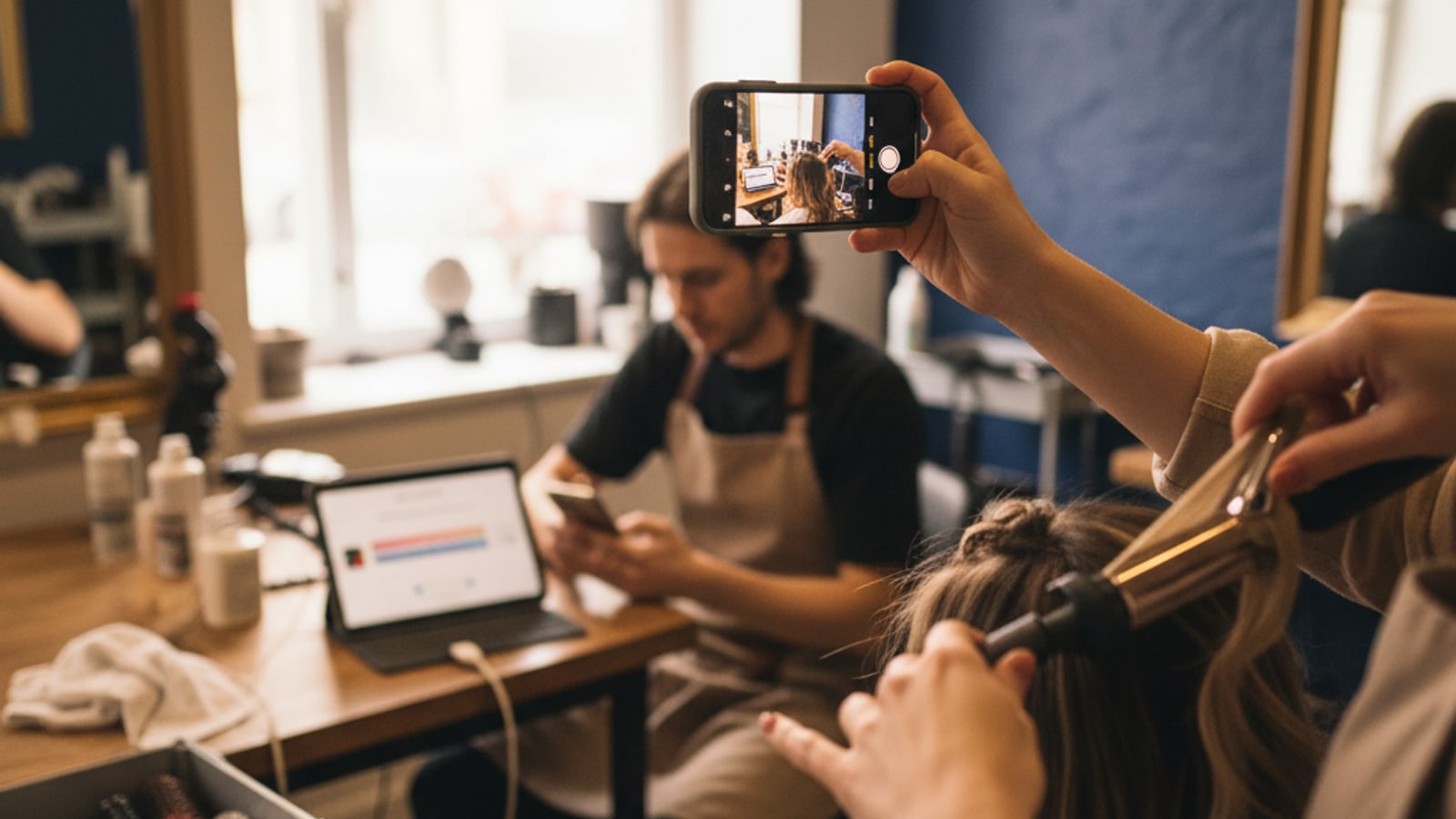
A social media multiplier built for a salon or barbershop fixes the time problem, the photo-release problem, and the stylist-brand problem in the same workflow. The input is small and sustainable — two to three short phone videos a month, recorded by stylists, barbers, or the owner, walking through whatever transformations and work are happening that month. A balayage from foil to gloss. A skin fade from clipper guard to finish. A color correction. A blow-out reveal. A quick technique demonstration. Two to four minutes each, dropped into a private upload link from the shop's phone the moment the client gives the okay. That is the entire ongoing time commitment from the shop — roughly thirty minutes a month, all in.
One video, a month of content
From those two or three videos, the multiplier produces a full month of finished content across every channel the shop cares about. Each video becomes vertical Reels and TikTok cuts, horizontal Facebook and YouTube versions, square feed clips, accurate captions in the shop's voice for each platform, a weekly Google Business Profile post, image carousels pulled from the b-roll, quote graphics from a stylist's strongest line, a section for the client email newsletter, and a stylist-taggable version each stylist can repost to their personal feed in one tap. Two to three monthly recordings typically yield 30 to 50 posts across channels. The Google Business Profile side specifically gets a weekly post in the same content stream, because consistent GBP activity is one of the prominence signals that influences whether the shop shows up in the local 3-pack for "haircut near me" and "balayage near me" searches — and the 3-pack is where the highest-converting local traffic lands.
Photo release gating every post
The photo-release workflow sits in front of the production pipeline. Every client-identifiable asset — a transformation Reel with the client's face in frame, a quoted testimonial, a recognizable chair-side clip — gets a one-page release signed before it ever reaches the posting queue. The form names the channels, the duration, and the revocation process. The front desk gets trained on when to surface it — typically at the cosmetic consult or right after a transformation the client is visibly delighted with — and signed releases get filed against the client record. If a client revokes after the fact, there is a documented takedown that pulls the post across every connected channel. Compliance becomes a workflow the shop runs by default, not a worried conversation after a regular sees herself on Instagram and asks for it down.
Stylist features that drive personal books
Stylist features sit at the center of the post mix. Each stylist on the team gets named features, signature-service clips, and transformation Reels tagged to their chair. Captions name the stylist, the booking link routes to their specific calendar, and a stylist-taggable version of each transformation is produced so each team member can repost to their personal Instagram or TikTok in one tap — keeping the shop's visual identity intact while letting each stylist build their personal book. The shop benefits from the compounding reach across the team's personal feeds. Stylists feel ownership of the content. The brand stays consistent across every account in the team. Professional Beauty's published guidance for the category reinforces that "Instagram is a dream platform for the visually minded" and that "videos are fab and connect people to you as the face of the company" — the multiplier puts each stylist's face in front of the camera in a way that compounds the shop's brand and the stylist's personal book at the same time.
What this changes for the shop business is the part that compounds. A visibly active transformation-heavy feed becomes a credibility signal to every prospective client who checks the shop before booking. Booksy's Instagram guide for the spa-salon-barbershop category specifically calls out that engagement rates on Instagram run roughly ten times higher than on Facebook for visual personal-care work, with 39% of users surveyed becoming more interested in a business after viewing its Instagram Stories — which is why the channel mix leans Reels-first for the category. The Google Business Profile side compounds in parallel: consistent weekly posting signals an actively managed listing, which feeds the prominence input to local ranking, which puts the shop in front of the client searching at the exact moment they have decided to book a haircut, a color appointment, or a beard service. None of this happens from one great Reel. All of it happens when the feed is visibly active for three to six months in a row, which is what the multiplier makes possible without anyone on the team writing a caption.
What we build for your salon
The setup runs three to four weeks from kickoff to live and lands as a system that runs on a two-to-three-videos-a-month input from the shop forever, without further engineering on the shop's end.
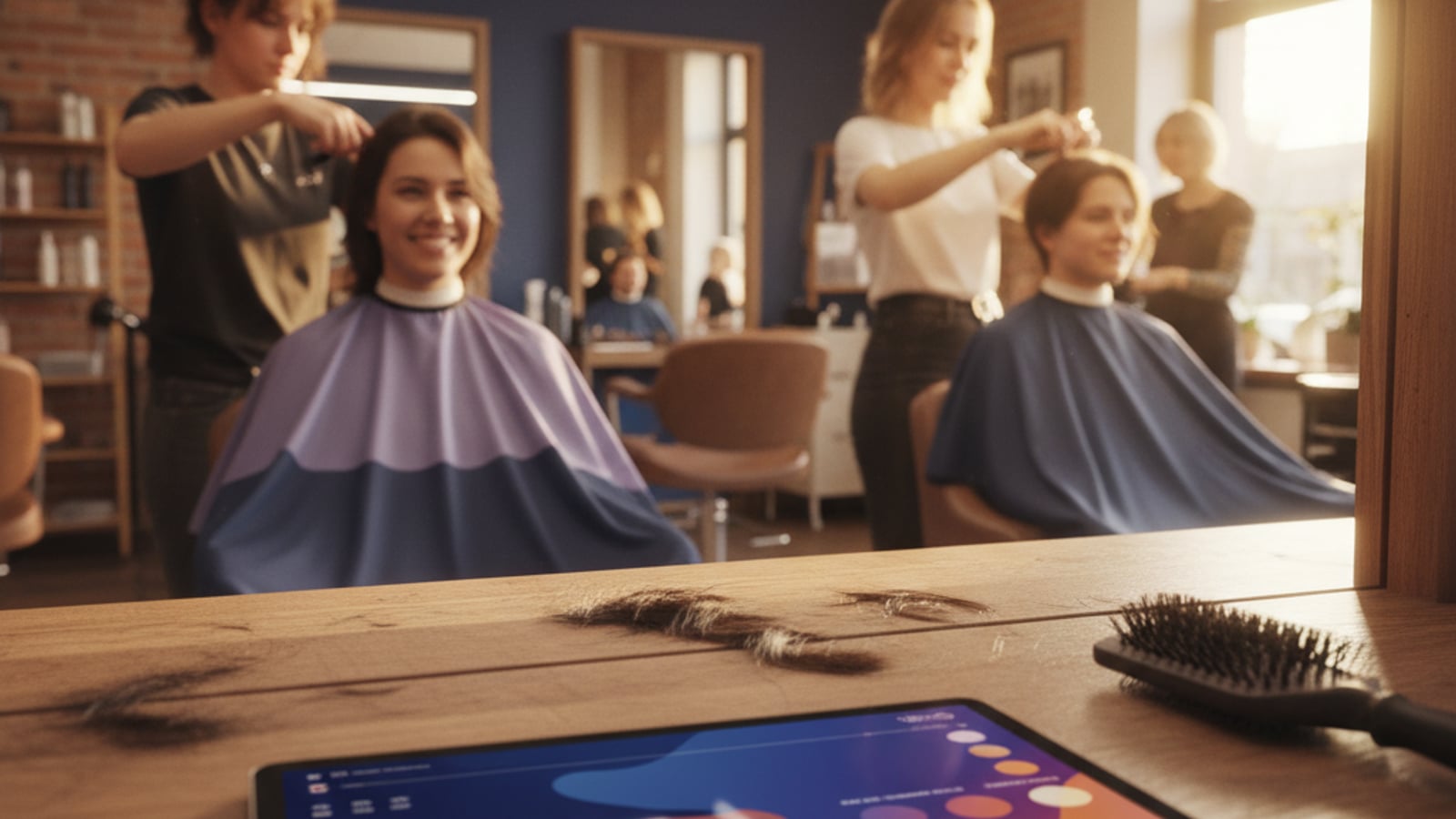
The photo-release workflow comes first. A one-page release form drafted to name the channels, the duration, and the revocation process, branded to the shop. A signed-release filing system tied to the client record so any post can be traced to a release in seconds. Training for the front desk on when to surface the form — at the cosmetic consult, right after a transformation reveal, during checkout for a client who is visibly delighted. A documented takedown process if consent is revoked. Nothing client-identifiable posts without a release on file.
The voice profile and visual identity capture comes next. We pull from the shop's existing client communications, booking confirmations, past captions that sounded right, and the way stylists actually talk about their work — and build a voice guide and a visual identity treatment that runs across every output. Fonts, color, frame treatment, lower-third style for stylist names, opening and closing card design. The treatment travels with every clip regardless of which stylist recorded the source footage. It also travels onto stylist-taggable repost versions, so when a stylist drops a transformation onto her personal feed, the shop's identity stays intact.
The multi-format production pipeline takes each uploaded video and produces vertical clips for Reels and TikTok, horizontal cuts for Facebook and YouTube Shorts, square feed versions, accurate auto-captioning verified against the transcript, image carousels built from b-roll and transcript pulls, quote graphics from the strongest lines, a long-form caption tuned to each platform's tone, a weekly Google Business Profile post, a section for the client newsletter, and a stylist-taggable version of each piece for personal-feed repost.
The stylist feature layer sits on top of the production pipeline. Each stylist gets named features in regular rotation, signature-service Reels tagged to their chair, and booking links that route directly to their specific calendar. Transformation captions name the stylist as the artist. The system tracks which stylists' content compounds best on which platforms and tunes the cadence accordingly.
The scheduling layer posts each format at the time the platform analytics show the shop's audience engages, paced across the week so the feeds stay actively updated without flooding any one day. The Google Business Profile gets a weekly post in the same content stream.
The engagement routing layer surfaces comments, DMs, and Google Business Profile messages to the right person on the front desk in the channel they already use — so the moment a prospective client lands warm, the team picks up the conversation and the automation steps aside.
The weekly report shows what went out, what performed, which stylists' content is doing the heaviest lifting, which transformation formats are getting the most saves and shares, and which local searches are driving the GBP impressions. The owner can scan it in two minutes and see the system getting sharper as it learns what the local audience responds to.
The shop stays in control of the input — what gets recorded, which transformations to feature, which stylists are in front of the camera that month. We do the building, the wiring, the release workflow, the testing, the production, and the tuning. After the system goes live, the shop's monthly task is recording two to three short videos and responding to the engaged-prospect notifications that land in the front desk's inbox.
Outcomes you should expect
What this delivers
- Keep the shop visibly active on Instagram, TikTok, Facebook, and Google Business Profile every week — without the owner thumbing through Canva at midnight or a stylist editing Reels between clients.
- Run a photo-release consent workflow so every before/after, every transformation Reel, and every client quote has a signed release on file before anything posts — protecting the shop from the most common social-media mistake in the category.
- Land 2 to 6 net-new bookings a month from organic Instagram, TikTok, and Google Business Profile findability, on top of the shop's existing walk-in and referral flow — typically taking 2 to 4 months to compound.
- Cut social-media production time from the 4 to 8 hours a week most shops try (and quietly drop after a month) down to roughly 30 minutes a month of phone-video recording by the owner or a stylist.
- Feature each stylist on the feed in a way that drives rebookings to their specific chair — so the social presence builds individual books, not just shop-level brand awareness.
- Maintain a weekly Google Business Profile post cadence — one of the prominence signals that influences whether the shop shows up in the local 3-pack for 'haircut near me' or 'balayage near me' searches.
- Build a brand stylists are proud to share — so when a stylist reposts a transformation to their personal feed, they grow their own book and bring foot traffic with them.
Industry data
By the numbers
Sprout Social's 2024 analysis, drawn from nearly 3 billion messages across more than a million public brand profiles between February 2024 and January 2025, puts the industry-average posting cadence at 9.5 posts per day across networks — roughly 5 on Facebook, 1-2 on Instagram, 2 on X, 1 on LinkedIn, and 1 on Pinterest per week — a volume no chair-side salon or barbershop can sustain by hand.
Booksy's salon marketing guidance is explicit that short-form video is the dominant currency of social engagement, with Reels and TikToks driving discovery while static photos remain valuable only as a presence and portfolio — and that high-impact before/after transformations 'capture attention instantly' when the source footage is the salon's own real client work.
Booksy's Instagram set-up guide for spas, salons and barbershops reports that engagement rates on Instagram are roughly ten times higher than on Facebook for visual personal-care work, and cites Facebook data showing 39% of users surveyed reported becoming more interested in a business's offerings after viewing its Instagram Stories — making Instagram the load-bearing channel for the category.
Industry guidance published by Pro Beauty Association puts the average internet user at over 17 hours per week on social media and lays down the bright-line content rule for salons: 'It's better to post infrequently but consistently than to post every single day for a period of time and then post nothing for weeks afterward' — and that before-and-after pictures are 'especially important' because they showcase salon work quickly and effectively.
Professional Beauty's published guidance for growing a salon's social media presence reinforces that the value of social for salons comes from sustained engagement and visual storytelling — not from one-off promotional blasts — with quoted industry pros noting 'Instagram is a dream platform for the visually minded' and 'videos are fab and connect people to you as the face of the company.'
Illustrative scenario
What this typically looks like
The scenario below is illustrative — a representative outcome for a business that fits this service profile, not a claimed client engagement.
This is an illustrative scenario, not a description of a specific client engagement. It shows the shape of the math the multiplier is built to deliver, not a promised outcome.
Picture a four-chair neighborhood salon in a walkable suburban district — three stylists and an owner who still takes a half-book of regulars. Today the Instagram has 612 followers, a last post from eleven weeks ago that pulled 9 likes, a TikTok with four videos from the year before, and a Google Business Profile that has not been touched since the holiday promotion ended. The shop pulls a steady but unremarkable flow of new-client inquiries — most from Yelp and Google directory listings, some from referrals, a small handful from organic search. The owner has tried to post personally twice and burned out both times. One stylist runs a strong personal Instagram with 4,200 followers but most of her posts are at her old shop's address.
After the multiplier goes live, the shop's monthly recording task settles into the rhythm. One stylist records a two-minute balayage walkthrough from foil application to gloss. The owner films a three-minute clip of a corrective color from consult to result. A barber on the team shoots a 90-second skin-fade clip from guard to finish. Those three videos become roughly 41 posts across Instagram, TikTok, Facebook, Google Business Profile, and the client newsletter over the following month — transformation Reels for the bulk of it, two stylist-feature carousels, one technique-focused TikTok that crosses over to barber-stylist accounts, and a behind-the-chair Saturday-morning clip. Every transformation has a signed release on file before it posts. Each stylist gets a stylist-taggable version of their own work and reposts to their personal feed in one tap.
Inside six weeks, the shop's Instagram reach climbs from a few hundred per post to a few thousand as the algorithm picks up the consistency. The Google Business Profile starts showing up in more "balayage near me" and "barber near me" searches in the surrounding ZIP codes as the prominence signal strengthens. By month three, the front desk hears "I saw your TikTok" or "I follow your stylist" on two or three new-client calls a week. By month six, organic social and Google Business Profile findability together are putting two to six net-new booked appointments a month on the schedule, with new clients increasingly requesting specific stylists by name from the first inquiry. The stylist with the strong personal Instagram updates her bio to the shop's address and starts driving foot traffic she used to bring to her old place. Setup paid for itself before month four at typical color-service prices.
The actual numbers will shift with the shop's local market, average ticket, chair count, and the strength of the source footage stylists bring in. The shape of the math holds.
Common questions
What buyers ask before reaching out
How do you handle photo releases for before/after transformation posts?
Every client-identifiable asset — a balayage transformation, a fade-haircut clip, a quote, a recognizable face in a chair-side video — runs through a signed photo release before it gets near a posting queue. We build the shop a one-page release form that names the channels, the duration, and the revocation process, train the front desk on when to surface it (typically at the cosmetic consult or after a transformation the client is delighted with), and store the signed releases against the client record. If a client revokes after the fact, the documented takedown process pulls the post across every connected channel. Nothing patient-identifiable posts without a release on file.
How do stylist features actually drive rebookings to specific chairs?
Stylists build personal books, not just shop brand awareness. The system features each stylist on the feed with a short profile clip, signature-service highlights, and transformation Reels tagged to their chair. Captions name the stylist, the booking link routes to their specific calendar, and the feed treats the team as named individuals instead of an anonymous shop. When a regular sees their stylist's transformation in their feed, the rebook happens in two taps. When a new client discovers the shop through a particular stylist's work, the system routes them to that chair from the first inquiry forward.
What kinds of content actually work for a salon or barbershop on social media?
Transformation content is the workhorse — balayage before/afters, color corrections, fade haircuts shot top-down, beard sculpting, blow-out finishes. It performs because the shift from before to after is the proof of the work in three seconds. Layered on top are technique Reels — how a stylist holds the shears for a specific cut, the brushwork on a balayage melt, the order a barber works through a skin fade — which travel well to other stylists and to clients who want to see craft. Behind-chair process clips, stylist profile features, and Google Business Profile posts round out the mix. Booksy's salon marketing guidance specifically calls out that 'high-impact transformations capture attention instantly' when the source footage is the salon's own real client work.
Do you post for us, or do we still have to be involved?
The only ongoing task on the shop's side is recording 2 to 3 short phone videos a month — a stylist walking through a transformation, a barber explaining a fade, an owner showing a behind-the-chair moment, a quick technique demonstration. Two to four minutes each. Drop them into a private upload link. From there the multiplier handles cutting into vertical Reels and TikTok clips, square feed cuts, captioning in the shop's voice, scheduling across Instagram, TikTok, Facebook, Google Business Profile, and email, and surfacing comments and DMs for the front desk to respond to. Before/after photos and any client-identifiable assets route through the photo-release workflow before they hit the queue.
How does this drive more bookings versus just being a vanity feed?
Two compounding effects. First, the Google Business Profile side — consistent weekly posts feed into the prominence signal Google uses for local 3-pack ranking, and a shop that shows up in the map pack for searches like 'haircut near me' or 'balayage near me' captures the highest-intent local traffic there is. Second, the Instagram and TikTok side — prospective clients who hear about the shop from a friend, a Google search, or a passing storefront frequently check the feed before booking. An active, transformation-heavy, recently-updated feed is what turns a passive look into a booked chair. Booksy's Instagram guide for the category notes engagement rates on Instagram run roughly ten times higher than on Facebook, which is why the channel mix leans Reels-first.
How is this different from the agency we used to pay $1,500 a month?
Most agencies at that price are running 30 to 50 salons and barbershops off the same content calendar — generic balayage stock photos and quote-card graphics that could have been any shop on their roster, captions stitched from a swipe file, no real footage of the actual stylists. A scrolling client can spot it. The multiplier here uses only the shop's own source footage — real transformations on real clients, real stylists in the chair, real behind-the-chair moments — and runs the team's actual voice through every caption. Volume is also higher — typically 30+ posts a month across channels versus an agency's 8 to 15, on a consent-checked workflow rather than a generic template.
What does Google Business Profile posting actually do for the shop?
A Google Business Profile post shows up directly in the shop's listing when someone searches the shop name or 'salon near me' or 'barbershop near me' in the local area. Consistent weekly posts signal to Google that the listing is actively managed, which feeds the prominence side of the local ranking algorithm — one of the inputs that decides whether the shop shows up in the 3-pack of map results above the organic listings. For a chair-based local business, the 3-pack is some of the highest-converting visibility there is, because the searcher has already decided they want a haircut or a color appointment; the question is which shop. The multiplier produces a weekly GBP post out of the same source footage as the Instagram and TikTok content, so it stays consistent without extra work.
What about stylists who want to use the content on their personal feeds?
Stylists growing their personal books is good for the shop — every repost on a stylist's personal Instagram is free reach into a network the shop's main account does not have. The multiplier produces a stylist-tagged version of each transformation and technique clip that stylists can repost to their own feed in one tap, with a caption template that names the shop, the booking link, and the stylist's signature services. The brand stays consistent across the team's personal accounts without anyone having to write captions. Stylists feel ownership of the content; the shop benefits from the compounding reach.
What does this typically cost a single-location salon or barbershop?
Setup for a single-location shop with 3 to 8 chairs usually lands in the $3-7K range — that covers the photo-release workflow build, the voice and visual identity capture, channel connections to Instagram, TikTok, Facebook, Google Business Profile, and the email list, plus the first 30 days of posting templates. Monthly run rate after that typically sits in the $400-1,000 range depending on how many stylists get individual feature treatment and how much editing the raw footage needs. We walk through the math against the shop's specific average ticket and chair count on the 15-minute fit call before anyone commits.
Ready to see what this looks like for your business?
A free 15-minute call. We talk about your business, the time and revenue you'd unlock with the right automation, and what the first 30 days could look like.