
Review Management for Salons and Barbershops — Fill Stylist Books
Post-service review asks at the 24-48 hour sweet spot, per-stylist routing so every book fills, and a private intercept on color or cut regret before the one-star review posts.
The problem
For most salons and barbershops, the gap between a fully booked shop and a half-empty Tuesday is not the quality of the work. It is what the public review profile says about that work, on the four platforms where new clients actually decide where to book — Google, Yelp, Booksy, and Vagaro.
The silent satisfied majority
A salon does eighty cuts and color services a week. Maybe one or two of those clients leave a Google review on their own. The handful of clients who had a bad day — the color that came out too brassy, the cut that was shorter than asked for, the wait that ran twenty minutes long — all go straight to the public review form because they have a reason. So the public scoreboard reads as if the shop is run by the worst Saturday of the year, every day forever. BrightLocal's Local Consumer Review Survey 2024 found that 71% of consumers would not consider using a local business with an average rating below three stars, and that 75% of consumers regularly read reviews before picking a local business. A 4.1 rating built from the angry minority is doing real damage to walk-ins and online bookings every single week.
Uneven per-stylist book fill
Booksy and Vagaro both surface reviews at the individual stylist level inside the shop's marketplace listing. When a new client searches for a haircut nearby and lands on the shop's Booksy or Vagaro profile, they often click straight into a specific stylist's calendar, look at that stylist's review count and rating, and book with whoever looks most credible. The result is predictable — the one senior stylist with 200 lifetime reviews stays booked solid for six weeks, while the three newer stylists with four or five reviews each run half-empty Tuesday through Thursday. The shop bears the same fixed cost on every chair, but only one chair is producing at capacity. None of it reflects how good the stylists actually are. It reflects who has accumulated public proof and who has not.
Color and cut regret going public
The two biggest sources of one-star reviews for a salon are clients who do not like how the color came out and clients who feel the cut was wrong. Both surface in the same 24 to 72 hour window, when the client has lived with the result long enough to know how they feel about it but still has not done anything about it. Without a path to flag the regret privately, the next thing that happens is the public one-star review goes up. The shop finds out three days later, often from a regular who saw it, and by then the review has been read by a hundred prospects.
After-hours bookers lost to a weak profile
Boulevard's salon retention research found that around 46% of salon bookings happen outside business hours, and that first-time clients who book online return for a second visit roughly 78% of the time versus 39% for walk-ins. The shop with a strong public profile across Google, Yelp, Booksy, and Vagaro catches those after-hours bookers. The shop with a weak profile loses them to the next shop on the search results, every single evening.

What changes for your business
The model is straightforward. For each client who completes a service at the shop, the system fires a single review ask in the 24-48 hour window after the appointment, routed to the right platform for that client and the right stylist's profile inside that platform. Alongside the public ask, the same client is offered an optional private feedback channel they can use to flag a problem directly to the owner. Every new public review on Google, Yelp, Booksy, and Vagaro is monitored daily and gets a reply in the shop's voice within the day. None of this is something the front desk has to remember to do between clients.
The 24-48 hour post-service ask
A client gets their haircut, color, or chemical service. Two days later — after the color has settled, the cut has been styled at home, the client has lived with the result through a normal day — a short, friendly SMS or email goes out in the shop's voice. It does not offer a discount, a free service, or any other incentive, because Google's Business Profile policy and the FTC's 2024 Consumer Reviews and Testimonials Rule both prohibit incentivized reviews. The ask routes the client to the platform where their review will do the shop the most good — usually Google for the Local Pack lift, but Booksy or Vagaro for the per-stylist book fill, depending on where that client originally booked.
Per-stylist routing on Booksy and Vagaro
When the client booked with Maya on Booksy, the post-service ask routes the review to Maya's Booksy profile, not to the shop's general Google profile. Maya's review count grows from her actual client base instead of the senior stylist soaking up all the credit. Over a few months, every stylist's book starts to fill from their own social proof, which means the shop runs closer to full capacity across every chair instead of one chair carrying the marketplace ranking.
Private intercept on color or cut regret
The intercept on color or cut regret runs in parallel. Every client, alongside the public review ask, is offered an optional private "tell us how we did" channel — separate from and parallel to the public review form, not replacing it. When the client flags a serious problem through that channel — the color is too dark, the cut is uneven, the chemical service did not give the result they asked for — an alert goes to the owner or stylist immediately, and a free-correction offer goes out the same day. Most color and cut regrets, when handled with a same-day call and a comp redo within the week, do not end up as one-star reviews. The client gets the result they actually wanted, the stylist gets a second chance to make it right, and the shop's public profile stays clean. This is different from review gating, which Google prohibits. Every client gets the same public review request regardless of how the visit went. The private channel is an additional option, not a filter on who can leave a public review.
For the shop, the outcome lands in three numbers within the first quarter. Public review volume per month rises — typically two to three times across Google, Yelp, Booksy, and Vagaro combined — because the silent satisfied majority finally has a frictionless path to leave the review they would otherwise have skipped. Average rating climbs by 0.3 to 0.7 stars, because the new asked-for reviews outweigh the historical complaint bias. Per-stylist review counts on Booksy and Vagaro start to even out across the team, so newer stylists' books fill from their own credibility instead of waiting years to accumulate it organically.
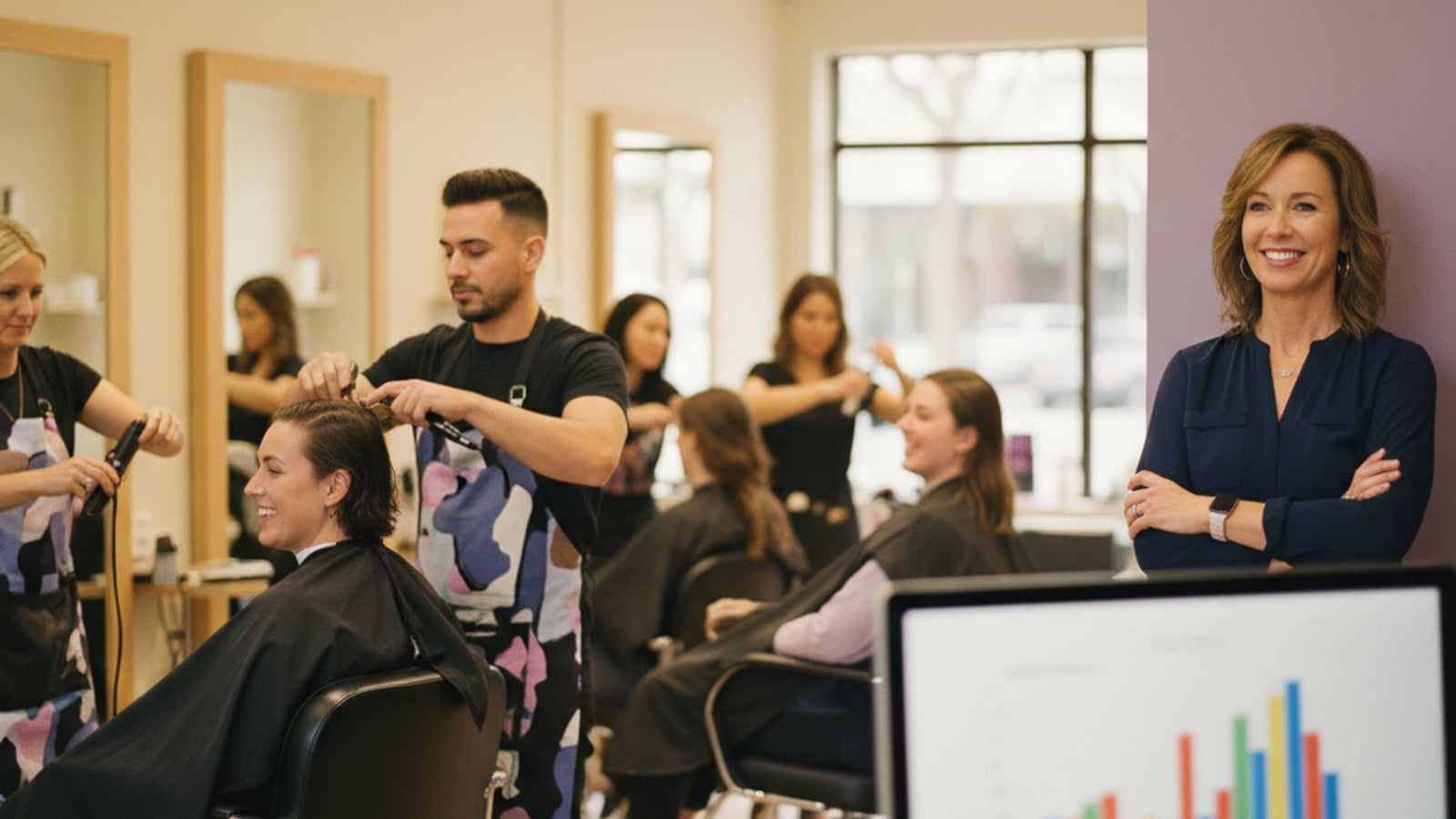
What we build for your salon
Setup runs three to four weeks from kickoff to live, scoped around your specific platform mix, chair count, and stylist roster. After the system is live, the only thing your team has to do is take the call when a private feedback alert lands — the same conversation you would have had at the front desk on the client's way out, just on every service instead of the ones where someone happened to be standing there.
What lands in the build. A connected trigger off your booking system — Booksy, Vagaro, Square, Fresha, or Boulevard — so every completed service automatically fires the post-service ask at the 24-48 hour mark, routed to the channel the client uses (SMS for most, email as a fallback). Custom-written ask copy in the shop's voice, with no incentive language and no sentiment steering, fully compliant with Google's Business Profile policy and the FTC's 2024 Consumer Reviews and Testimonials Rule. Per-stylist routing on Booksy and Vagaro so a client who booked with Jess gets routed to Jess's profile and a client who booked with Maya gets routed to Maya's, with the routing logic confirmed against your actual platform setup.
A private feedback channel offered as an optional second link in the same post-service message — separate from and parallel to the public review ask, available to every client regardless of how the visit went. Real-time alerts to the shop owner or manager the moment a private feedback message surfaces a color, cut, or service concern, with a simple workflow for who calls the client back and inside what window. A free-correction offer template ready to go when the call happens, so the comp-redo conversation is consistent across the team. Daily monitoring of Google Business Profile, Yelp, Booksy, and Vagaro, with every new public review surfaced the day it lands. Professional public replies on every review in the shop's voice within the day — five-star reviews get a warm thank-you that names the stylist, three-star reviews get a thoughtful acknowledgement, one-star reviews get an apology, a brief description of what the shop did about it, and an invitation to call the owner directly.
A monthly report that shows new reviews by platform, per-stylist review counts and ratings, current Google rating trend, how many private feedback alerts came in and how they were resolved, and which ask timing and channel is producing the most reviews for your specific client base. The program keeps getting sharper over time instead of going stale on the configuration we shipped in week three.
The shop stays in control of the ask copy, the reply tone, and the free-correction policy. BoostFrame does the routing, the writing, the monitoring, and the daily reply work. Every reply that goes public reads like it came from the shop, because it does — we just removed the step where someone on your team had to remember to write it between clients.
Outcomes you should expect
What this delivers
- Typically 2-3x more public reviews per month across Google, Yelp, Booksy, and Vagaro once the 24-48 hour post-service ask is live, sized to your actual transaction volume so the pace stays believable.
- Per-stylist review counts climb on Booksy and Vagaro, so each chair's book fills from name-based searches instead of the shop relying on one or two senior stylists to carry the marketplace ranking.
- Color and cut dissatisfaction gets intercepted in the 24-48 hour window — the client gets a free correction offer routed to the owner before the one-star review posts, so the bad outcome turns into a saved relationship instead of a public screenshot.
- Google Business Profile rating typically climbs 0.3-0.7 stars in the first 90 days, which moves the shop up the Local Pack for the searches that drive walk-ins.
- Every public review across Google, Yelp, Booksy, and Vagaro gets a reply in the shop's voice within a day — covering the 88% of consumers who prefer a business that replies to every review.
- Compliant with Google's review policy and the FTC's 2024 Consumer Reviews and Testimonials Rule — no incentivized reviews, no review gating, no language that puts the shop's profile or its license-holder owner at risk.
Industry data
By the numbers
BrightLocal's Local Consumer Review Survey 2024, a representative panel of 1,141 US consumers, found that 88% of consumers would use a business that replies to all of its reviews, compared with just 47% who would use a business that does not respond at all, and that 81% of consumers used Google as their primary platform for reading reviews of local businesses.
The same BrightLocal 2024 survey found that 71% of consumers would not consider using a local business with an average rating below three stars, and that 75% of consumers reported reading online reviews on a regular basis before choosing a local business.
Boulevard's salon retention research, summarized in its industry trends report, found that first-time clients who book online return for a second visit roughly 78% of the time versus about 39% for walk-ins, and that around 46% of all salon bookings happen outside business hours.
Google's official Business Profile policy on prohibited and restricted content prohibits offering any incentive — including payment, discounts, or free goods or services — in exchange for posting a review, and also prohibits selectively soliciting positive reviews from customers while discouraging or diverting negative ones, the practice known as review gating.
The U.S. Bureau of Labor Statistics projects employment of barbers, hairstylists, and cosmetologists to grow 5% from 2024 to 2034, with about 84,200 openings per year — meaning new and existing shops are competing for chair time inside a growing pool of stylists, and the public review profile is increasingly the differentiator that decides where a new client books.
Illustrative scenario
What this typically looks like
The scenario below is illustrative — a representative outcome for a business that fits this service profile, not a claimed client engagement.
This is an illustrative scenario, not a description of a specific client engagement. The numbers below show how the math typically lines up for a shop of this shape.
Picture a four-chair neighborhood salon doing roughly 180 services a week — a mix of cuts, color, balayage, and chemical services across four stylists, with the senior stylist Maya carrying the Booksy reviews and the other three stylists Jess, Alex, and Devon each sitting at five to ten reviews. The shop's Google rating is 4.2 from 87 lifetime reviews accumulated over five years, the last one posted three months ago. They pick up about one new Google review per month on average. A one-star review hits the Google profile every other month, usually a Saturday color regret that goes public on Monday morning. The senior stylist Maya is booked solid for six weeks out on Booksy; the other three stylists have Tuesday-through-Thursday gaps the front desk struggles to fill.
After the program goes live, the post-service review request fires automatically 36 to 48 hours after each appointment, routed through the channel that client used to book — SMS for Booksy clients, email for the shop's website bookings, and the platform's own messaging where it integrates cleanly. Roughly 12 to 18% of clients leave a public review off that ask, well below 100% but a massive increase over the baseline of well under 1%. Inside the first 60 days, the shop is averaging 30 to 40 new public reviews per month across Google, Yelp, Booksy, and Vagaro combined.
Per-stylist routing puts Jess, Alex, and Devon each at 15 to 25 new Booksy reviews inside the first 90 days. New clients searching Booksy for a balayage in the area start finding Jess's profile competitive with Maya's and booking with her at a Wednesday slot Maya cannot offer. Average Google rating climbs from 4.2 to 4.6 inside 90 days as the satisfied majority finally posts. The private feedback channel surfaces three or four color or cut regrets each month — the owner calls each client, comps a correction within the week, and most of those clients stay regulars instead of posting the one-star review they were going to write. The one-star reviews that still do land get a same-day reply in the shop's voice that acknowledges the issue and offers a direct conversation, so the next prospect reading the profile sees a shop that listens.
None of those numbers is a promise for any specific shop. The exact ranges depend on the shop's baseline rating, the chair count, the platform mix the clients actually use, and how quickly the team can return the private feedback call. The shape of the math holds across most salons and barbershops.
Common questions
What buyers ask before reaching out
Why does timing matter so much for the review ask after a salon visit?
The 24-48 hour window after a haircut, color, or chemical service is the sweet spot. Inside that window the client has had a chance to live with the result — the color has settled, the cut has been styled at home once, the chemical service has rinsed out the formality of the salon visit — and the memory of the chair time, the conversation, and the result is still vivid. Ask in the first few hours and the client is often still in transit or has not styled the cut themselves yet. Wait past 72 hours and the goodwill has washed out under whatever else happened that week. We tune the exact send time per shop based on your average service type and your client base's response patterns.
How does the per-stylist review thing work on Booksy and Vagaro?
On Booksy and Vagaro, each stylist has their own profile inside the shop's listing — their own service menu, their own calendar, and their own review feed. When a new client searches for a haircut in your area and lands on your shop, they often scroll into a specific stylist's profile, see how many reviews that stylist has and what the rating is, and book with the stylist who looks most credible. A shop with one senior stylist at 200 reviews and three newer stylists at 4 reviews each ends up with the senior stylist's book solid for six weeks and the other chairs running half-empty. The ask we build routes the review to the right per-stylist profile, so every chair builds its own social proof and every stylist's book fills.
What is the pre-emptive intercept on a color or cut the client does not like?
Color regret and cut regret are the two biggest sources of one-star reviews for salons, and they usually surface in the same 24-48 hour window the review ask goes out in. Alongside the public review request, every client gets an optional private feedback channel they can use to flag a problem directly to your shop. When a client uses that channel to say the color is too dark or the cut is shorter than they wanted, an alert goes to the owner or manager so a free-correction offer goes out the same day. Most color and cut regrets, when handled with a same-day call and a comp redo, do not end up as one-star reviews. The client gets the result they wanted, the shop keeps the relationship, and the public profile stays clean.
Isn't routing unhappy clients to a private channel the 'review gating' that Google bans?
No, and the distinction matters. Review gating means selectively sending only happy clients to the public review form while diverting unhappy ones away from it. The intercept we build sends every client the same public review request to the same public platform, no filtering. The private feedback channel is offered to every client as an optional, additional way to reach the owner — separate from and parallel to the public review request, not replacing it. Anyone can use either channel, regardless of whether they are happy. That structure complies with Google's Business Profile policy and the FTC's 2024 Consumer Reviews and Testimonials Rule. It is also exactly what a well-run shop does at the front desk on the client's way out — offer a way to talk to the owner if anything was off — except now it happens for every client, not just the ones standing at the desk when the owner is there.
Does this work with Booksy, Vagaro, Square, Fresha, and Boulevard?
Yes, with different connection depth depending on the platform. Booksy and Vagaro both expose appointment data the system can read to trigger the post-service ask at the right time and route the review to the right stylist's profile. Square and Fresha both support webhook-based triggers we can hook into. Boulevard has a richer integration surface that lets the flow run inside the platform's own messaging where the shop already manages client communications. We confirm exactly what is reachable for your specific platform and version on the first call, before promising anything.
How does this move the shop up in the Google Local Pack?
The Local Pack — the three-shop map result that shows up when someone Googles 'hair salon near me' or 'barbershop open now' — ranks heavily on three signals for personal-care services: number of reviews, average star rating, and review recency. A shop with 87 lifetime reviews at 4.2 stars and the last one from six months ago loses to a shop with 240 reviews at 4.7 stars and a new review every week. The program drives the review volume from your real client base, the higher average rating from finally hearing the silent satisfied majority, and the recency from the steady weekly drip of post-service asks. The shop climbs the Local Pack without buying ads, and the lift in walk-ins and online bookings shows up inside the first quarter for most shops.
Does this cover Yelp as well as Google?
Yes. Yelp still matters for salons and barbershops, especially in dense urban markets and for the demographic that searches Yelp before Google for personal-care services. The system monitors Yelp the same way it monitors Google — every new review surfaces the day it lands, a reply in the shop's voice goes out within the day, and the review-ask routing accounts for whichever platform a given client is most likely to engage with based on their booking channel and prior behavior. Yelp's own review-solicitation rules are stricter than Google's, and the ask copy is written to comply with both.
What does this cost a typical salon or barbershop?
Pricing scopes to the shop. A single-chair barbershop with one platform to monitor and one stylist to route reviews to runs lighter than a six-chair salon with Google plus Yelp plus Booksy plus Vagaro and per-stylist routing on each. Most shops land in the $2-5K range for setup plus a monthly platform cost in the low hundreds. The Harvard Business School research on Yelp ratings — Michael Luca's working paper on Yelp.com — found a one-star rating bump drives a 5 to 9 percent revenue increase for independent businesses, which for most salons pays the program back inside the first quarter. We walk through your specific numbers on the 15-minute fit call.
Ready to see what this looks like for your business?
A free 15-minute call. We talk about your business, the time and revenue you'd unlock with the right automation, and what the first 30 days could look like.