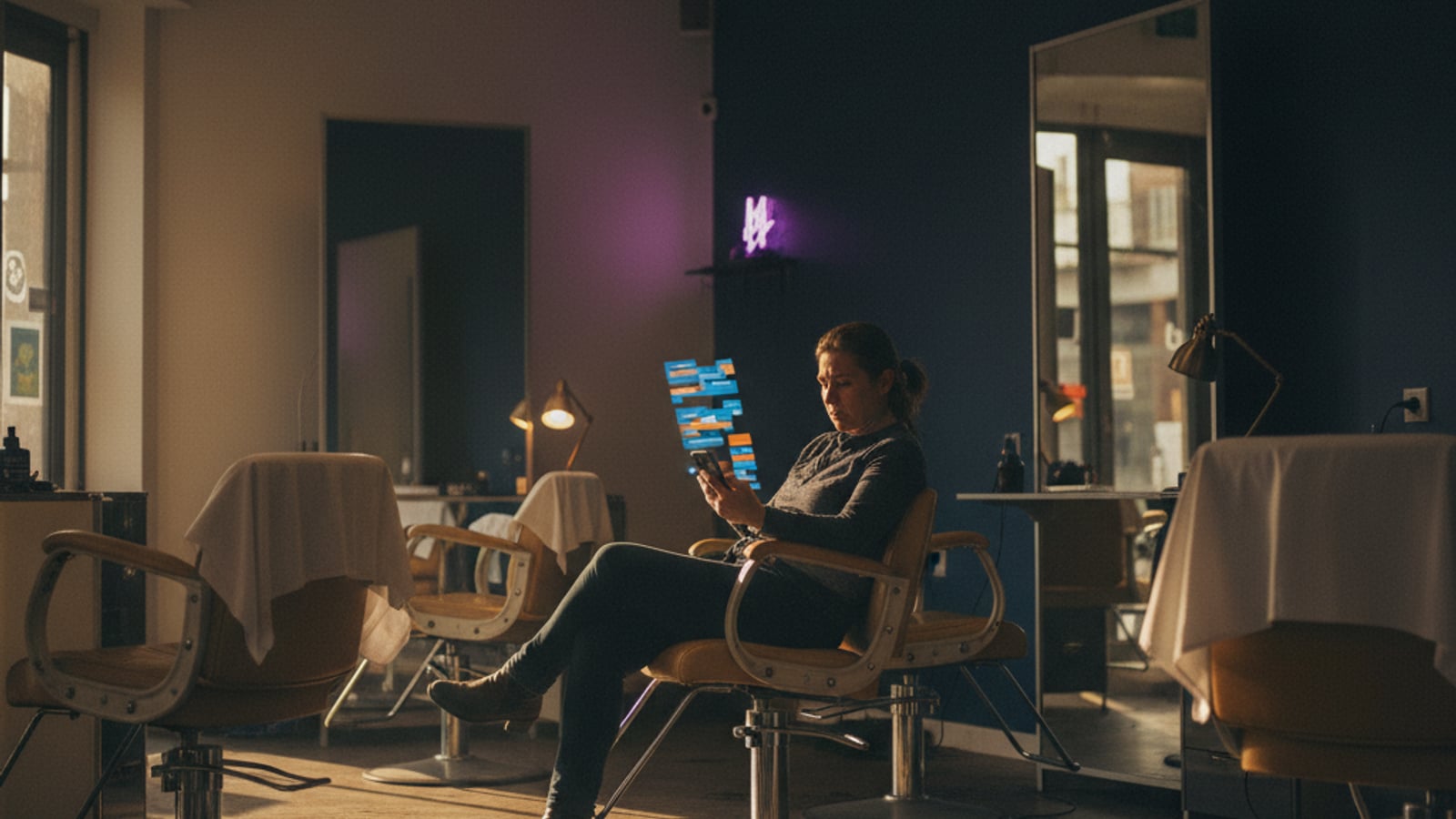
AI Chat Assistant for Salons and Barbershops — 24/7 Booking Help
A 24/7 chat assistant that answers service and pricing questions on your website and handles Instagram DMs in your shop's voice — without changing your booking system.
The problem
Most of the new-client revenue that walks out of a salon or barbershop walks out at the same handful of moments. A client lands on the website at 10pm Tuesday wanting to know if you do balayage on dark hair. A first-timer sends an Instagram DM at 8pm Saturday asking about beard line-ups for their teenager. A walk-in shopper checks Google at 6:45pm on the way home from work wondering if you're still open. None of these are difficult questions. All of them go unanswered, because the shop is closed and nobody is sitting on the website or the DM inbox.
After-hours shoppers go unanswered
The shape of that loss is well-measured. Boulevard's salon industry research puts roughly 46-50% of all salon bookings outside business hours, with one study showing 64% of clients book outside standard 9-to-5 windows and 75% prefer online booking. Salesloft's analysis of over 30 million chat conversations found that 39% of conversations and 41% of meetings booked happened outside 9-to-5 — and that a 5-minute response delay raised visitor abandonment risk by 10x, with a 10-minute delay pushing it to 100x. The buyer is not weird for shopping at 10pm. The buyer is normal. The shop just has no way to answer at that hour.
DMs eating the owner's evenings
The same problem repeats during the day in a different shape. Owners and front desks lose hours every week thumb-typing the same five answers — hours, pricing on common services, which stylist does what, whether you take walk-ins, whether you do kids — to Instagram DMs and website chats between clients in the chair. The owner of a busy four-chair salon often spends fifteen evening minutes catching up on DMs that all asked variations of "do you do balayage and how much." On Saturdays it's worse. And the client who waited two hours for a reply often booked somewhere else in the meantime.
Color prep instructions get forgotten
Color services have their own slow leak. The colorist's pre-appointment instructions — come with hair washed within 24-48 hours but not the morning of, wear a dark shirt, arrive at a certain time for the patch test, expect a three-hour appointment — are the kind of thing that gets forgotten and causes a chair to run twenty minutes long. Multiply that across a week and the calendar quietly compresses, the colorist falls behind, and the last client of the day gets the rushed version of their service.
Forgetfulness driving no-shows
Underneath all of this is the no-show problem. Booksy's industry data puts average no-show rates for appointment-based businesses in the 10% to 15% range, with about 28.4% of those misses driven by the client simply forgetting the booking — a clean win for any structured reminder flow, but only if the shop has a way to actually send them in the client's preferred channel.
These are not problems the front desk is doing wrong. They are problems of coverage. There is no team in the country that can answer Instagram DMs at 9pm, catch website visitors at 10pm, send color prep instructions for every booking, and answer the phone all day while also checking in clients. The hours are not there.

What changes for your business
An AI chat assistant gives a salon or barbershop a working way to answer at the hours the front desk cannot — without adding a person to the payroll or asking the stylists to type answers between clients. The assistant lives on your website as a chat bubble and, when you want, hooks into your Instagram DMs and your Google business profile messaging. It runs every minute those channels are up.
Real menu, real prices, your voice
The assistant is built around three things: your real service menu, your published prices, and your shop's voice. When a client lands on the website at 10pm asking about balayage on dark hair, the assistant gives the honest answer — what your stylists actually do, what the starting price is, how long the appointment runs, who the colorist is, and a link to your booking flow. When a first-timer DMs Instagram on Saturday night asking about beard line-ups for their teenager, the assistant answers in your shop's voice using the same service and pricing info, and either drops the booking link or captures the contact for Monday morning. When a walk-in shopper checks the Google profile at 6:45pm, the assistant answers the wait-time and hours question and points them at the next available window.
Guardrails and clean handoff
The guardrails are most of the work. The assistant is given a defined scope — your services, your prices, your stylists, your policies — and is explicitly told what to escalate. Custom color quotes, corrective work, chemical service questions, complaints, anything that needs a stylist's judgment — those get a polite "let me have someone on the team get back to you" and a clean handoff with the conversation context. HubSpot's customer service research found that 92% of CS leaders say AI has improved their response and 53% cite 24/7 coverage as a top benefit, but the same body of research is clear that consumers want a human option visible at all times. The assistant we build is upfront about being automated and offers a human handoff on every screen.
Color prep that fires automatically
Color prep instructions ride on the same system. When a client books a color appointment through your booking platform, the assistant sends the prep instructions your colorist would otherwise have to remember to text — wash timing, what to wear, patch-test arrival window, what the appointment runs, what to expect afterward — automatically. The client shows up ready. The colorist isn't catching them up at the chair. Booksy data suggests structured reminders alone can cut no-shows by up to 70%, and prep instructions stack on top of that as a quality signal that makes the appointment less likely to drift.
Platform-neutral booking handoff
The booking system stays where it is. The assistant is platform-neutral. If you run Booksy, the client gets routed to your Booksy page with the right service preselected. Same for Square, Vagaro, Fresha, and Boulevard. The depth of any direct connection depends on what your specific platform exposes — we tell you on the first call what is reachable and what isn't, and we don't promise integrations we have not actually built. Your booking system stays the source of truth for appointments.
For your shop, what changes is concrete. After-hours website and DM visitors get an answer in seconds instead of waiting twelve hours. The owner stops thumb-typing the same five replies on Instagram. Color appointments run on time because the prep went out automatically. Walk-in shoppers on Google get a working answer instead of clicking through to the next shop. The front desk gets noticeably fewer routine calls, freeing real time for the client in the chair and the call that actually needs a person.

What we build for your salon
The setup runs two to three weeks from kickoff to live and lands as a working assistant your team does not have to think about after week three.
What gets shipped: a chat bubble on every page of your website, in your brand and your shop's voice, available every minute the site is up. A defined scope of questions the assistant can answer — your services, your published pricing, your stylists and their specialties, your hours and walk-in policy, kids' cuts, color services and how they work, location and parking — all sourced from your real shop info and reviewed with you in writing before anything goes live. A defined escalation list — custom color quotes, corrective work, chemical service questions, complaints, anything outside scope — that hands off to your front desk or to you directly with the conversation context attached. Optional Instagram DM coverage that catches the same questions in the same voice, so the owner stops being the bottleneck. Optional Google business profile messaging coverage for walk-in shops where the local-search-to-walk-in path matters.
For shops doing color work, we wire up the prep-instruction flow — the assistant sends the colorist's standard prep checklist when a color service is booked through your booking platform, including wash timing, what to wear, patch-test arrival window, and appointment length. The instructions are written in your colorist's voice, not a generic template.
We connect the assistant to whichever booking system you already run — Booksy, Square, Vagaro, Fresha, Boulevard — at the depth that platform supports. Most shops have the assistant route clients to the booking system's existing flow with the right service preselected, which is a clean handoff that doesn't require us to promise a deep integration we have not built. Full TCPA-compliant opt-out and consent handling is built into any SMS that fires from the chat, so the shop stays inside the rules without anyone on your team having to think about it.
You get a weekly report that shows what the assistant did — how many website conversations, how many DMs, what clients asked about, how many routed to your booking link, how many handed off to a human, and what the assistant said "I don't know" to. That last list is how the scope keeps getting sharper instead of going stale. After it goes live, the only thing your team has to do is pick up the conversation when a handoff lands.
Outcomes you should expect
What this delivers
- Answer the service, pricing, stylist, and walk-in questions clients send at 10pm Tuesday — so they book with you instead of the next shop on the search results.
- Handle the steady drip of Instagram DMs asking about balayage prices, kids' cuts, and beard line-ups without the owner thumb-typing replies between clients.
- Send prep instructions for color services — washed-out hair photos, what to wear, arrival time, patch-test rules — automatically when the appointment is confirmed.
- Give walk-in shops a working way to answer wait-time and service availability questions on the website and Google profile, in the shop's voice.
- Free your front desk and your stylists from answering the same five questions a dozen times a day so they can focus on the client in the chair.
- Stay platform-neutral — the assistant lives on your website and DM channels and hands off to whichever booking system you already run (Booksy, Square, Vagaro, Fresha, Boulevard).
Industry data
By the numbers
Boulevard's salon retention research found that roughly 46-50% of salon bookings happen when the shop is closed and that one study showed 64% of clients booked outside standard 9-to-5 hours, with 75% using online booking platforms — meaning the after-hours window is where a meaningful share of new revenue is actually decided.
Boulevard's industry data found first-time clients who book online return for a second visit roughly 78% of the time, versus about 39% for walk-ins — close to a 2x retention difference that hinges on whether the shop can capture the booking at the moment of interest.
Booksy industry data places average no-show rates for appointment-based businesses in the 10% to 15% range, with about 28.4% of those misses driven by clients simply forgetting the booking — the single largest driver of lost chair time.
Booksy reports that salons sending structured appointment reminders can cut no-shows by up to 70%, with SMS and push notifications cited as the most effective channels because clients read them almost immediately on receipt.
Salesloft's Conversational AI Marketing Trends Report, analyzing more than 30 million Drift conversations, found that 39% of all conversations and 41% of all meetings booked happened outside the standard 9-to-5 window — and that a 5-minute response delay increased visitor abandonment risk by 10x, with a 10-minute delay pushing it to 100x.
HubSpot's State of Customer Service research found that 53% of customer service leaders cite 24/7 support coverage as a top benefit of using AI in customer service, with 92% of CS leaders saying AI has improved their response — making always-on chat a baseline expectation rather than a premium feature.
Illustrative scenario
What this typically looks like
The scenario below is illustrative — a representative outcome for a business that fits this service profile, not a claimed client engagement.
This is an illustrative scenario, not a description of a specific client engagement. It shows how the math typically lines up for a representative shop.
Picture a four-chair neighborhood salon with two senior stylists, a colorist, and a junior — running roughly 120 service appointments a week with a healthy Instagram following of about 4,500 local followers. The owner answers DMs from her phone between clients and again at home at night. On a typical week the shop gets 60-80 website visits after hours, 15-25 DM inquiries, and a few Google profile messages, all asking variations of the same questions: hours, services, prices, walk-in availability, kids' cuts, who does balayage and what it runs. Today, the after-hours website visitors get nothing. The DMs get answered when the owner has a minute, which is sometimes the next morning. A meaningful chunk of those inquiries book somewhere else in the meantime.
After installing the chat assistant on the website, hooking it into Instagram DMs, and wiring color prep instructions to fire from the booking system, the shop typically sees a few things shift over the first 60-90 days. The website starts capturing 8-15 after-hours conversations a week that previously left without a trace, with a portion of those routing into the booking system and a portion handed off as warm Monday-morning callbacks. The DM inbox stops piling up — the assistant answers the first 70-80% of routine questions and routes the rest to the owner with the context attached, which typically saves the owner 4-6 hours of thumb-typing per week. The color column runs noticeably tighter because clients show up with the right wash timing and the right arrival window.
None of those numbers are dramatic on their own. Together, in the typical shape we see, they translate to a handful of recovered new-client bookings per month from after-hours capture, a meaningful reduction in owner DM time, and a colorist who isn't running twenty minutes behind by 2pm. Actual numbers depend on the shop — baseline traffic, social following, current booking system, and how cleanly the assistant's scope is drawn.
Common questions
What buyers ask before reaching out
What does an AI chat assistant actually answer for a salon or barbershop?
It answers the questions clients ask before they book — your hours, your address and parking, the services you offer and what they cost, which stylists work which days, whether you take walk-ins on Saturdays, whether you do kids' cuts, who your colorist is and what they specialize in, and what a first visit looks like. It uses your real service menu and your shop's voice, not a generic script. When a client asks something the assistant doesn't know — a complex color quote, a chemical service question, a complaint — it hands off cleanly to your front desk with the conversation context already captured.
Does it work with my booking system — Booksy, Square, Vagaro, Fresha, or Boulevard?
The assistant is designed to sit alongside whichever booking system you already run, not replace it. For most shops, the assistant answers the question in chat and then sends the client to your booking system's existing flow with the right service preselected. The depth of any direct connection depends on what your specific platform exposes — we tell you on the first call what is reachable and what is not, and we don't promise integrations we have not actually built. Your booking system stays the source of truth for appointments.
Can it handle our Instagram DMs?
Yes, and for a lot of shops this is the single biggest day-to-day relief. Instagram is where new clients discover the shop and ask the first questions — 'Do you do balayage on dark hair?' 'How much is a beard trim?' 'Are you open Sunday?' — and most owners end up thumb-typing the same answers from the chair between clients. The assistant catches those DMs, answers in your voice using the same service info that powers the website chat, and either routes the client to your booking link or captures the contact for a follow-up. The owner stops being the bottleneck.
Will the chat assistant give clients wrong pricing or quote a service we don't actually do?
Not when it's built with proper guardrails, which is most of the work. The assistant is given a defined scope — your real service menu, your published prices, what you do and explicitly do not do — and it is told to escalate anything outside that scope to a human. For services where the price varies (custom color, corrective work, extension installs), the assistant says so plainly, gives the published starting price if you have one, and offers to set up a quick consult instead of guessing. The failure mode is a bot that bluffs. The system we build is one that refuses to bluff.
What about prep instructions for color services — can it send those automatically?
Yes, and this saves real chair time. When a client books a color service, the assistant can send the prep instructions your colorist would normally have to remember to text — come with hair that has been washed within 24-48 hours but not the morning of, what to wear, arrival time for the patch test, how long the appointment will run, what to expect on the way out. The client shows up prepared, the appointment runs on time, and the colorist isn't catching them up at the chair.
How does it handle walk-in shops versus appointment-only shops?
Walk-in-heavy barbershops get the most lift from real-time wait-time and availability answers, plus capturing contacts from clients shopping the area at 7pm. The assistant can answer 'How long is the wait right now?' if you keep a simple status field updated, and it can capture the contact of a client deciding between three shops on Google. Appointment-only salons get the most lift from service and pricing questions, color prep instructions, and after-hours booking routing. Most shops are some mix of the two, and the assistant's scope is tuned to match.
Will clients be annoyed by talking to a bot instead of someone at the shop?
Only if the bot is bad. Most clients shopping for a salon or barbershop at 10pm just want a fast answer — what does balayage run, do you take walk-ins on Sunday, do you do kids — and a well-built assistant gives them what they need in seconds and gets out of the way. The assistant is upfront that it's automated, gives short useful answers in your shop's voice, and offers a human handoff on every screen. The clients who want a person get one. The clients who just want your Sunday hours get them and move on.
How long does the setup take and what does it cost?
A typical salon or barbershop build runs two to three weeks from kickoff to live. Week one is gathering your real service menu, pricing, stylist info, and shop voice. Week two is wiring the assistant into your website, your DM channels, and the booking platform you already use. Week three is testing with real client questions and tuning the responses. Pricing is scoped on the first call — a single-chair barbershop wanting basic FAQ and DM handling looks different from a six-stylist salon wanting the full website plus Instagram plus prep-instruction setup. No per-message charges scaling with volume.
Who actually does the work — is this offshore?
BoostFrame is run by Bill Fackelman, the founder, in Oaklyn, NJ. Strategy, build, and ongoing tuning are handled in-house. You get a single point of contact who learns your shop, your service menu, and your voice — not a rotating account manager passing you between teams. For specialized creative or volume tasks we sometimes layer in trusted contractors, but one person owns the work.
Ready to see what this looks like for your business?
A free 15-minute call. We talk about your business, the time and revenue you'd unlock with the right automation, and what the first 30 days could look like.