
Social Media for Gyms & Fitness Studios — No Sunday Scramble
Transformation arcs with consent, class-spotlight reels, member-of-the-month features, and a weekly Google Business Profile cadence — without the owner editing on a Sunday night.
The problem
Every gym and boutique studio owner has had the same Sunday-night conversation about social media. The Instagram should be more active. The competitor studio two miles away is posting transformation reels every week. A new class format launches on Monday and the only announcement that goes out is a flyer at the front desk. The owner tried to handle it personally for a month — got three solid weeks of posts up, then a busy week killed it. The front desk got handed the assignment and dropped it the first morning the schedule got rough. The agency that took it on at $1,500 a month sent generic workout graphics that could have been any studio in the country. Meanwhile a prospective member lands on the studio's profile from a Google search, sees a feed where the last post was six weeks ago, and quietly books a trial somewhere else.
Posting cadence the team can't hit
The volume the platforms reward is brutal for a small business. Sprout Social's 2024 analysis, drawn from nearly 3 billion messages across more than a million brand accounts, puts the average posting cadence at 9.5 posts per day across networks — roughly five Facebook posts, one to two Instagram posts, two on X, one on LinkedIn. No owner-operated studio is hitting that by hand, and most cannot sustain even three posts a week through a busy quarter. The result is a feed that looks abandoned to a prospect who lands there from a "yoga near me" search, even when the studio is packed and the classes are great.
A crowded local field
The local field is also more crowded than ever. The Health & Fitness Association's 2025 US Health & Fitness Consumer Report found the US fitness industry reached 77 million members in 2024 — a 5.6% increase over 2023, with one in four Americans aged six and older holding a fitness facility membership. That growth is real money for studios that show up in the search, the algorithm, and the 3-pack. It is invisible to studios whose profile looks frozen in spring.
Recognition content is retention fuel
The third pressure is the early-membership window where most of the studio's churn lives. ABC Fitness, citing the HFA Benchmarking Report, notes that fitness operators lose roughly a third of their member base every 12 months, with cancellations clustered in the first three months and particularly between months two and three. Member-of-the-month features, transformation arcs, and class-spotlight content do not just acquire new members — they give existing members the public recognition that meaningfully lifts the odds they stay past the months-two-and-three cliff. Dr. Paul Bedford's analysis of 78,071 member visits, reported by ABC Fitness, found a single conversation between a member and staff increased the likelihood of returning the following month by 20%. Member-recognition content is the same recognition logic, scaled across the whole roster.
The cost of staying quiet does not show up as a line item on the studio's P&L. It shows up as the trial booking that went to the studio across town. It shows up as the new-class launch that nobody outside the existing roster knew about. It shows up as the member who would have been featured, would have shared the post with their network, would have brought two friends — but instead drifted out at the eight-week mark because the studio did not publicly recognize them in time.
What changes for your business
A social media multiplier built for a fitness studio fixes the time problem, the consent problem, and the brand-consistency problem in the same workflow.
30-minute monthly recording task
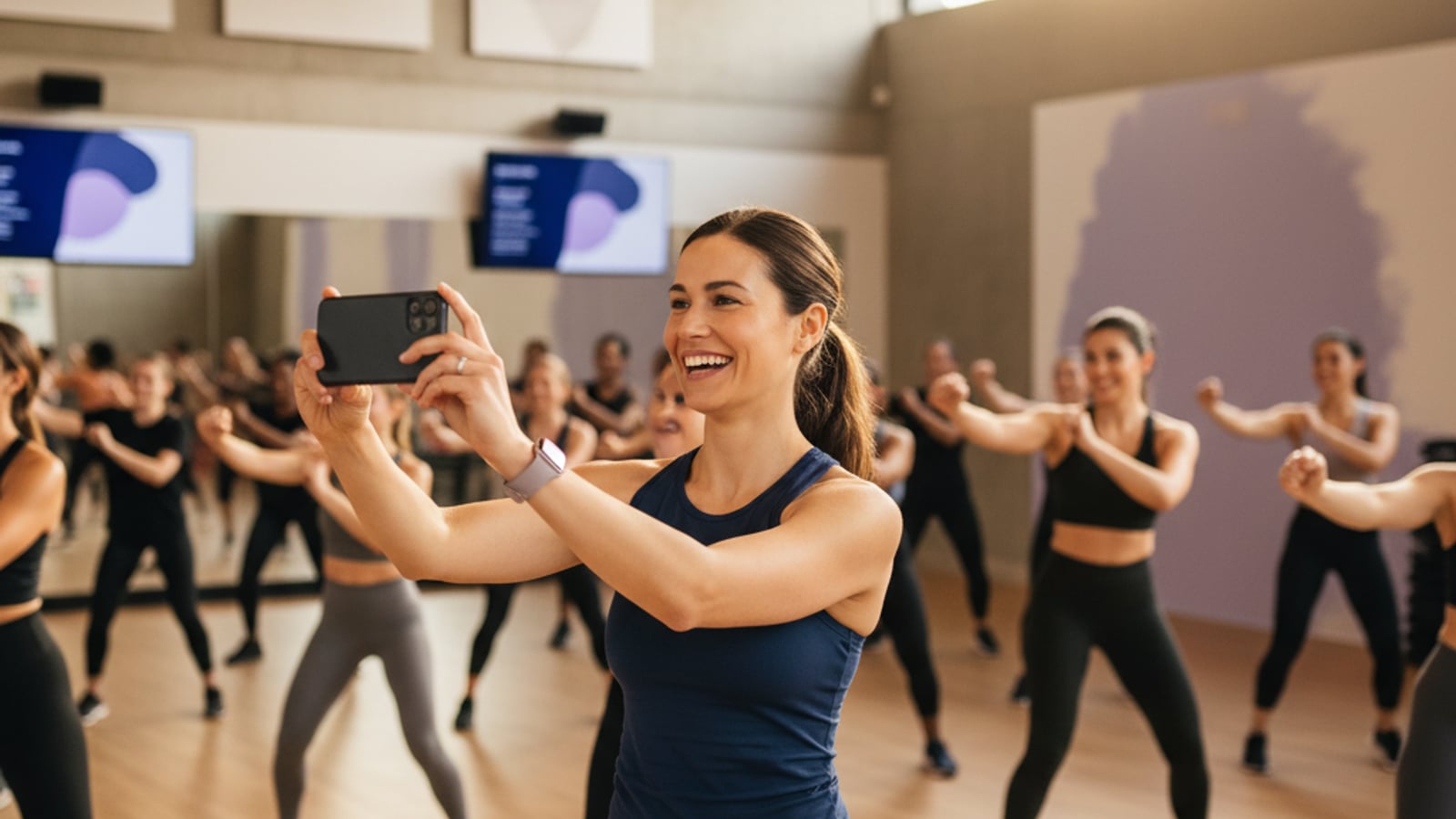
The input is small and sustainable — two to three short phone videos a month, recorded by the owner, a coach, a willing member, or the front desk. A trainer walking through a class format and the energy of the room. A member sharing what eight weeks of training has changed for them, with consent on file. A behind-the-scenes look at the Saturday morning rush. A schedule walk-through for the new spring program. Two to four minutes each, dropped into a private upload link from any phone on the studio floor. That is the entire ongoing studio task — roughly thirty minutes a month, all in.
Multi-format output from one upload
From those two or three videos, the multiplier produces a full month of finished content across every channel the studio cares about. Each video becomes vertical reels for Instagram and TikTok, horizontal cuts for Facebook and YouTube, square feed posts, image carousels built from b-roll and the transcript, quote graphics from the strongest line, captions written for each platform in the studio's voice, a weekly Google Business Profile post, a section for the member newsletter, and a short blog excerpt linked to the studio's service pages. Two to three monthly recordings typically yield 30 to 50 posts across channels. Sprout Social's 2025 benchmark data shows Reels hitting a 2.46% engagement rate — well above static feed posts — which is why class-spotlight and trainer-feature reels carry the heaviest conversion load in the mix.
Mix tuned for trials and retention
The content mix is tuned for what actually moves trial bookings and retention in a fitness business. Class-spotlight reels showing the real energy, music, and coaching style of each class — so prospects self-select into the format that fits them before they ever book. Trainer features that humanize the coaching team and let a curious prospect pre-pick the trainer they want to start with, which lowers the trial-to-first-class friction meaningfully. Member-of-the-month and transformation arcs (with written consent on file) that answer the prospect's real question of whether the studio works for someone like them — and double as the retention recognition that lifts the odds existing members stay past the early-churn cliff. Class-schedule reels for new program launches that convert curious followers into trial bookings the same week. Community and behind-the-scenes moments that build local brand recognition in the studio's actual neighborhood.
Consent-respectful transformation workflow
The consent-respectful transformation workflow sits in front of the production pipeline. Every member-identifiable asset — a before/after, a transformation testimonial, a recognizable member in a class reel, a member-of-the-month feature — gets a one-page written release on file before it reaches the queue. The release covers what is being shared, where it appears, how long it stays up, and how the member can revoke. Front desk gets trained on when to surface it — typically at the milestone moment when the member is happy to be on camera. Revocations trigger a documented takedown across every connected channel. Consent stops being an ad-hoc text message between the owner and a member and becomes a workflow the studio runs by default.
Brand consistency across contributors
Brand consistency lives at the multiplier layer, not at the recording layer. The voice profile is built from the studio's existing member communications — welcome emails, intake materials, the way the owner signs off on the schedule announcement, the words the team actually uses on the floor. The visual identity — fonts, color, lower-third treatment, frame style — runs across every output regardless of who recorded the source footage. The owner records on a Tuesday, a coach on a Friday, a member on a Saturday. Three different humans on camera. One coherent studio brand on the feed.
What this changes for the studio business is the part that compounds. A visibly active feed becomes a credibility signal to every prospective member who checks the studio before booking a trial. Consistent weekly Google Business Profile posting feeds the prominence input to local 3-pack ranking, which puts the studio in front of the prospect at the exact moment they have decided to start training. Member recognition through the content stream meaningfully lifts retention through the months-two-and-three window where most early churn happens. None of this happens from one viral reel. All of it happens when the feed is visibly active for six months in a row, which is what the multiplier makes possible without anyone on the team writing a caption.

What we build for a fitness studio
Setup runs three to four weeks from kickoff to live and lands as a system that runs forever on a two-to-three-videos-a-month input from the studio, without further engineering on the studio's end.
The consent-respectful release workflow comes first. A one-page release form branded to the studio. A signed-release filing system tied to the member record. Training for the front desk on when to surface the form — at the transformation milestone, at the member-of-the-month moment, before a class-spotlight reel features recognizable faces. A documented takedown process for revocations that pulls the post across every connected channel within hours. Nothing member-identifiable publishes without a release on file.
The voice profile and visual identity capture comes next. We pull from the studio's existing welcome emails, intake materials, schedule announcements, any past posts that sounded like the studio — and build a voice guide and a visual identity treatment that travels with every output. Fonts, color, lower-third style, opening and closing card design. The treatment runs across every clip regardless of who recorded the source.
The multi-format production pipeline takes each uploaded video and produces vertical reels for Instagram and TikTok, horizontal cuts for Facebook and YouTube Shorts, square feed clips, accurate auto-captioning verified against the transcript, image carousels from b-roll and transcript pulls, quote graphics from the strongest lines, long-form captions tuned to each platform's tone, a weekly Google Business Profile post, a section for the member newsletter, and a blog excerpt linked to the studio's service pages.
The scheduling layer posts each format at the time the platform analytics show the studio's specific audience engages — Sunday-evening reach windows for the schedule-planning crowd, late-afternoon for the post-work browse, early-morning for the gym-bag-packing audience. The Google Business Profile gets a weekly post in the same content stream.
The engagement routing layer surfaces comments, DMs, and Google Business Profile messages to the right person on the front desk in the channel they already use — so the moment an engaged prospect lands, the team picks up the conversation and the automation steps aside.
The weekly report shows what went out, what performed, which formats are doing the heaviest lifting, which moments from the source footage are getting cut and reused most often, and which local searches are driving GBP impressions. The owner can scan it in two minutes and see the system getting sharper as it learns what the studio's local audience responds to.
The studio stays in control of the input — what gets recorded, who appears on camera, which classes and members get featured. We do the building, the wiring, the consent flow, the testing, the production, and the tuning. After the system goes live, the studio's monthly task is recording two to three short videos and responding to the engaged-prospect notifications that land in the front desk's inbox.
Outcomes you should expect
What this delivers
- Keep the studio visibly active on Instagram, Facebook, TikTok, and Google Business Profile every week — without the owner or front desk editing reels on a Sunday night.
- Turn each new class launch, trainer hire, or schedule change into a paced multi-format announcement instead of a single dead post that scrolls past by Tuesday.
- Run a consent-respectful transformation-content workflow so member success stories, before/after content, and member-of-the-month features have written permission on file before anything publishes.
- Land more trial-class bookings from organic social and Google Business Profile findability — typically 3 to 8 net-new trial sign-ups a month within the first 3 to 6 months as the cadence compounds.
- Build local brand recognition in the studio's actual neighborhood, so when a prospective member finally decides to try a class, the studio's name is the one they already remember.
- Cut the time the owner or front desk spends on social-media production from 4 to 8 hours a week (which most studios quietly abandon by month two) down to roughly 30 minutes a month of phone-video recording.
Industry data
By the numbers
The Health & Fitness Association's 2025 US Health & Fitness Consumer Report found the US fitness industry reached 77 million members in 2024, a 5.6% membership increase over 2023, with one in four Americans aged six and older (24.9%) holding a fitness facility membership — meaning the local audience a studio is competing for is the largest it has ever been, and so is the field of studios competing for them.
ABC Fitness, citing the HFA 2025 Benchmarking Report, notes fitness operators lose roughly one-third of their member base every 12 months, with most cancellations clustered in the first three months and particularly between months two and three — making the early-membership window the part of the funnel where social-driven trial bookings and member-recognition content compound the most.
ABC Fitness reports that Dr. Paul Bedford's analysis of 78,071 member visits found a single conversation between a member and staff increased the likelihood of returning the following month by 20%, and members with four or more monthly staff interactions were 80% more likely to return — the same recognition logic that makes member-of-the-month and class-spotlight content work as retention fuel, not just acquisition fuel.
Sprout Social's 2024 analysis of nearly 3 billion messages across more than one million public brand profiles puts the industry-average posting cadence at 9.5 posts per day across networks — roughly five on Facebook, one to two on Instagram, two on X, and one on LinkedIn — a volume no owner-operated fitness studio can hit by hand without a content system.
Sprout Social's 2025 Content Benchmarks data shows Instagram Reels reach a 2.46% engagement rate — substantially above static feed posts — and short-form video under 60 seconds is the brand content format audiences are most likely to interact with on the platform, which is why class-spotlight and trainer-feature reels outperform almost every other format a studio can publish.
ABC Fitness's gym marketing guide identifies content marketing — blogs, social posts, videos, and member spotlights — as one of the seven tactics that compound for fitness businesses, and frames Google reviews and social presence as the modern prominence signals that drive new-member acquisition into a studio alongside email and paid social.
Illustrative scenario
What this typically looks like
The scenario below is illustrative — a representative outcome for a business that fits this service profile, not a claimed client engagement.
This is an illustrative scenario, not a description of a specific client engagement. It shows the shape of the math, not a promised outcome.
Picture a single-location boutique studio in a suburban market — yoga, pilates, or HIIT format, four to six hundred active members, a couple of coaches plus an owner-operator and a front-desk lead. Today the Instagram has 740 followers, a last post from five weeks ago that pulled 18 likes, a TikTok account that was set up last year and sat dormant, and a Google Business Profile that has not been touched since the spring schedule change. Trial-class bookings sit in a steady but unremarkable range — most from word-of-mouth referrals, some from insurance partnerships, a small handful from organic search. The owner tried to post personally twice and burned out both times.
After the multiplier goes live, the studio's monthly recording task settles into a rhythm. A coach records a two-minute class-format walk-through showing the energy of the Tuesday-evening HIIT class. A long-time member, with signed consent on file, records a three-minute transformation share covering twelve weeks of training. The owner films a thirty-second schedule announcement for the new Sunday-morning mobility class launching the following week. Those three videos become roughly 42 posts across Instagram, Facebook, TikTok, Google Business Profile, and the member newsletter over the following month — class spotlights and trainer features for the bulk of it, the transformation arc broken across multiple reel cuts and a feed carousel, the new-class launch announced across every channel, plus two behind-the-scenes Saturday-morning clips.
Inside six weeks, Instagram reach climbs from a few hundred per post to a few thousand as the algorithm picks up the consistency. TikTok, finally active, starts pulling local impressions the studio did not previously have access to. The Google Business Profile begins surfacing in more "[format] near me" searches in the surrounding ZIP codes as the prominence signal strengthens. By month three, the front desk hears "I saw your video" from two or three trial-booking conversations a week. By month six, organic social and Google Business Profile findability together are typically putting three to eight net-new trial bookings a month on the schedule — at a setup cost that paid for itself before month four at typical member-LTV math, and a monthly run cost that pencils against a single retained member per month.
Actual numbers shift with local market, class format, member-LTV math, and the strength of the source footage. The shape of the math holds.
Common questions
What buyers ask before reaching out
How do you handle consent for transformation content and member features?
Every member-identifiable asset — a before/after, a transformation testimonial, a member-of-the-month spotlight, a recognizable face in a class reel — runs through a written consent flow before anything reaches the posting queue. We build the studio a one-page release form covering what's being shared, where it appears, how long it stays up, and how the member can revoke consent. The front desk gets trained on when to surface it (typically at the milestone moment when the member is happy to be on camera), and signed releases get filed against the member record. Revocations trigger a documented takedown across every connected channel. Nothing patient-style sensitive posts without a release on file.
What kinds of content actually move the needle for a fitness studio?
Five things compound. Transformation content with consent — the longer arc of a member's journey, not just a before/after photo — drives the highest trial-conversion lift, because it answers the prospect's real question of whether the studio works for someone like them. Class-spotlight reels showing actual class energy, music, and coaching style help prospects self-select into the format that fits them. Member-of-the-month and member-recognition features double as retention fuel — recognition is one of the strongest predictors of whether a member stays past the months-two-and-three churn cliff. Class-schedule reels for new-launch programs convert curious followers into trial bookings. Trainer features humanize the coaching team and let prospects pre-pick the trainer they want to start with. The mix that compounds is roughly 35% class spotlights and trainer features, 25% transformation and member features, 20% schedule and launch announcements, 20% community and behind-the-scenes.
Do we have to be on camera every week? Our coaches are busy.
No. The studio's monthly recording task is two to three short phone videos — a trainer talking through a class format, a member willing to share their progress, a quick behind-the-scenes look at a Saturday morning, or an owner walking through what's coming up on the schedule. Two to four minutes each. Upload them through the private link we give you. The multiplier handles the cutting into vertical reels, square feed clips, captions in the studio's voice, scheduling across Instagram, Facebook, TikTok, and Google Business Profile, and the engagement-routing back to the front desk. Total ongoing studio time is roughly 30 minutes a month.
How does this actually drive trial-class bookings instead of just being a vanity feed?
Two compounding effects. The Instagram and TikTok side — prospective members who hear about the studio from a friend, a Google search, or a walk-by check the social feed before booking a trial. An active feed full of recent class energy, member transformations, and trainer features turns a passive look into a booked intro. The Google Business Profile side — consistent weekly GBP posts are one of the prominence signals that influences whether the studio shows up in the local 3-pack when someone searches 'yoga near me' or 'pilates studio [town]', which is some of the highest-converting visibility there is for a local studio. Sprout Social's 2025 benchmark data shows Reels hit a 2.46% engagement rate, materially above static posts, which is why class-spotlight reels carry so much of the conversion work.
How is this different from a $1,500-a-month social media agency?
Most agencies at that price are running 20 to 40 studios off the same content calendar — generic transformation graphics, stock workout footage, captions that could have been any studio. The member looking at the feed can usually tell, and the local prospect comparing two studios in town can tell instantly which one is real. The multiplier here uses only the studio's own source footage — your trainers, your members (with consent), your space, your music if licensing allows — and runs the team's actual voice through every caption. Volume is also higher, typically 30 to 50 posts a month across channels versus an agency's 8 to 15.
What about brand consistency when the owner, coaches, and front desk all contribute footage?
The voice profile and visual identity sit at the multiplier layer, not at the recording layer. The owner might film a Monday-morning schedule walk-through, a coach might shoot a class-format explainer Wednesday, a front-desk lead might grab a Saturday-morning energy clip. Three different humans on camera. One coherent studio brand across the feed — same captioning tone, same lower-thirds, same color treatment, same paced cadence. The team gets the variety; the prospective member sees a studio with a clear identity.
What does Google Business Profile posting actually do for a studio?
A weekly Google Business Profile post shows up directly in the studio's listing when someone searches the studio name or a local query like 'yoga studio near me'. Consistent weekly posts signal to Google that the listing is actively managed, which influences the prominence input to local 3-pack ranking — the map results that sit above the organic listings. For a neighborhood fitness studio, the 3-pack is where a prospect who has already decided to start training is choosing between two or three studios. The multiplier produces a weekly GBP post out of the same source footage used for Instagram and TikTok, so consistency comes for free.
What does this typically cost a single-location studio?
Setup for a single-location boutique studio usually lands in the $4-8K range — that covers the consent workflow build, the voice and visual identity capture, channel connections to Instagram, Facebook, TikTok, Google Business Profile, and the email list, plus the first 30 days of posting templates. Monthly run rate after that typically sits in the $400-1,200 range depending on how many channels are live and how much editing the raw footage needs. We walk through the math against the studio's specific average member value, trial-conversion baseline, and local market on the 15-minute fit call before anyone commits.
Ready to see what this looks like for your business?
A free 15-minute call. We talk about your business, the time and revenue you'd unlock with the right automation, and what the first 30 days could look like.